Friday, November 30, 2007

Independent minyanim in the New York Times!

The independent minyan phenomenon has made it to the New York Times!

Without a building and budget, Tikkun Leil Shabbat is one of the independent prayer groups, or minyanim, that Jews in their 20s and 30s have organized in the last five years in at least 27 cities around the country. They are challenging traditional Jewish notions of prayer, community and identity.

In places like Atlanta; Brookline, Mass.; Chico, Calif.; and Manhattan the minyanim have shrugged off what many participants see as the passive, rabbi-led worship of their parents’ generation to join services led by their peers, with music sung by all, and where the full Hebrew liturgy and full inclusion of men and women, gay or straight, seem to be equal priorities.

Members of the minyanim are looking for “redemptive, transformative experiences that give rhythm to their days and weeks and give meaning to their lives,” said Joelle Novey, 28, a founder of Tikkun Leil Shabbat, whose name alludes to the Jewish concept of tikkun olam, or repairing the world. It is an experience they are not finding in traditional Jewish institutions, she said.


These communities have been documented in the press before, but mostly in Jewish publications (plus a short piece in Time), and now this article is reaching a much wider audience (including Christian bloggers who refer to us as "Satan's market"). It will be interesting to see the reactions.

I was interviewed for the article, but didn't make it into the final cut. Unfortunately, due to scheduling conflicts, the reporter (based in DC) wasn't able to make it to Kol Zimrah in New York.

Five good things about this article:
  1. The quote above from Joelle Novey makes it clear that participants in independent minyanim are there out of a serious commitment to meaningful Judaism, and not because we're looking for something more watered down or because we're looking for a singles scene.
  2. The article emphasizes that this is a nationwide phenomenon, bringing examples from Denver and the Kansas City suburbs, rather than confining coverage to a few coastal blue cities.
  3. Demonstrating a fresh perspective that is perhaps only attainable by going outside the Jewish press, the article addresses this phenomenon on its own terms, and doesn't get caught up shoehorning it into angst about intermarriage, "continuity", "affiliation", the future of institutions, etc.
  4. "A survey that Mr. Landres has undertaken with Mr. Cohen and Rabbi Kaunfer indicates that rather than taking young Jews out of the synagogue pews, they are taking them out of their beds on Saturday mornings." Hopefully synagogues will read this article and begin to understand that independent communities aren't driving people away from synagogues; synagogues are driving people away from synagogues. This generation wasn't joining synagogues before the increase in new independent communities at the turn of the millennium either. (And I look forward to the results of the survey, which are supposed to be released today.)
  5. The article emphasizes the minyanim's openness towards participants learning to lead services, etc., and active steps that the minyanim are taking to help participants gain new skills. This counters the meme out there that independent minyanim are "elitist" and only for people with extensive prior Jewish education.

Five questionable things in the article:

1. The word "traditional" is being overloaded with at least two different meanings (which is par for the course): "conventional" (as in traditional IRA vs. Roth IRA), vs. "traditional Judaism" (whatever that means). Is a "traditional synagogue" one that has a rabbi and a building and conventional institutional structures, or one that follows "traditional" Jewish practice? There isn't really a positive or negative correlation here, and there's no way to tell which is being referred to except from context. Compare:
  • "They are challenging traditional Jewish notions of prayer, community and identity." -> unclear which, perhaps both
  • "It is an experience they are not finding in traditional Jewish institutions, she said." -> "conventional"
  • "For instance, its once-in-three-weeks services alternate between one with circular seating and a more traditional service, in which the chairs face east and the singing is a cappella." -> "traditional Judaism"
  • "Rabbi Edward Feinstein is one leader of a traditional synagogue who applauds the development of the minyanim." -> "conventional"

2. Havurot are referred to in the past tense. In fact, many of the havurot founded in the late '60s and '70s are still around. The article says, apparently to create a contrast, "The minyanim are largely urban." In fact, the major havurot founded in the '60s and '70s (e.g. Havurat Shalom, the New York Havurah, Fabrangen) are/were also urban. I think this distinction between "minyanim" and "havurot" is misleading. Yes, there are minyanim that are not havurot (e.g. rabbi-led minyanim in synagogues), and there are havurot that are not minyanim (e.g. havurot that get together only for non-prayer activities, since a minyan is by definition a prayer group), but all of the communities under discussion could be accurately described as both minyanim and havurot. In fact, this fuzziness can be observed in their self-descriptions. Tikkun Leil Shabbat (founded 2005), one of the "minyanim" featured in the article, refers to itself on its website as a havurah. The Highland Park Minyan (founded 197x), which is representative of the havurot founded at that time, refers to itself in its name as a minyan.

Certainly, there are discernible differences between independent Jewish communities founded in the 1970s and independent Jewish communities founded in the 2000s, though not necessarily all that much larger than the differences between Tikkun Leil Shabbat and DC Minyan (both founded in the 2000s and featured in the article), and not large enough to negate the fact that all these communities are fundamentally manifestations of the same phenomenon. (That said, even though the creation of new grassroots Jewish communities has continued uninterrupted since the 1960s, the rate and popularity have skyrocketed since the turn of the millennium, so this story is indeed newsworthy as current news.) Many core participants in the post-2000 independent communities are also active participants in the National Havurah Committee (founded in the late 1970s), whose network and Institutes have been vital in the creation and sustenance of many of these communities.

3. "The fact that women at the minyanim can lead prayers and read the Torah is central to their popularity, including among those raised in the Orthodox tradition, which limits women’s participation in services." I have to say that this section of the article was surprising to me. To be sure, gender egalitarianism was a major chiddush for the early havurot, since many of their participants came from the Conservative movement (which was generally not egalitarian at the time), and the havurot were egalitarian. Today, participants in independent Jewish communities come from all movements, and the independent communities themselves include both communities that are fully egalitarian and communities that aren't. So it wouldn't have occurred to me to list gender egalitarianism as a significant difference between synagogues and independent communities. Every Jewish community I have been a part of since birth, whether institutional or independent, has been gender-egalitarian, so that's not a factor in my choice to participate in independent communities, and some people are participating in independent communities that are less gender-egalitarian than the synagogues they grew up at.

So all that said, here's a (perhaps Tosafot-like) way to read this that makes sense: Yes, even in the absence of independent communities, someone who grew up in a (non-egalitarian) Orthodox congregation could still have joined a(n egalitarian) Reform or Conservative synagogue. But if s/he were to do that, s/he would likely be missing out on the positive (non-gender-related) sociological aspects of Orthodox communities. Independent minyanim/havurot (the egalitarian ones, anyway) provide a way to get these positive elements while also having a fully egalitarian community. On the flip side, someone who grew up in an egalitarian synagogue who is looking to find these positive elements now has the option of going to an egalitarian independent community, rather than having to go to a non-egalitarian Orthodox synagogue.

So it's not that independent communities on the whole are more gender-egalitarian than synagogues on the whole; it's that if you compare an independent community and a synagogue that have comparable levels of Jewish education, active lay participation, sense of community, etc., then the independent community is more likely to be more gender-egalitarian.


4. "Tikkun Leil Shabbat draws Reconstructionist Jews, Orthodox Jews and everyone in between." Grrr. It's the one-dimensional linear spectrum. I won't belabor this, since I've said enough about it in the past. It's interesting that "Reconstructionist" is chosen as one end of the spectrum; it's a less conventional choice than the usual "Reform" or "secular". When people try to line up the movements from left to right, they often can't decide whether Reconstructionist belongs between Reform and Conservative (they have more Hebrew than Reform! but less than Conservative!), or at one end past Reform (they had LGBT equality before it was popular!). Which really should clue people in that the linear spectrum just doesn't work, but somehow it doesn't.

5. "A flowering of Jewish day schools in the 1980s produced a generation with a strong Jewish education and 'the cultural wherewithal to create their own institutions,' said Steven M. Cohen, a professor of sociology at Hebrew Union College-Jewish Institute of Religion." I agree with everything in this statement from "produced" onward, as well as the following sentence crediting Hillel experience with empowering this generation. But the significance of day schools in this empowerment is an unproven conjecture. I have it on good authority that the founders of Kol Zimrah (and the majority of its current steering committee) did not go to day school. Perhaps the survey results will tell us more.

Thursday, November 29, 2007

כ"ט בנובמבר

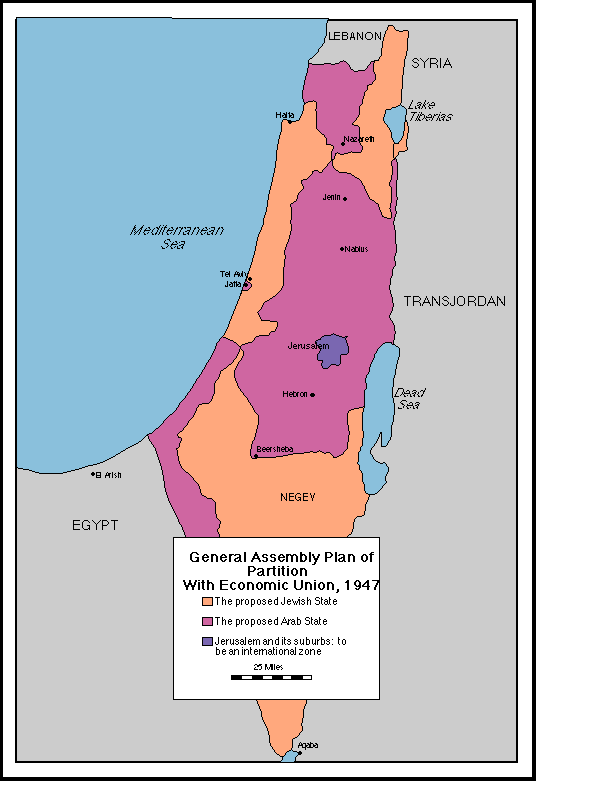
Today we celebrate the 60th anniversary of the two-state solution!


עוד לא אבדה תקוותנו ... להיות עם חופשי בארצנו

Tuesday, November 27, 2007

BREAKING NEWS: Jerusalem divided

(crossposted to Jewschool)


The Annapolis conference convened today, bringing together delegations from around the world. Many expected (indeed, some hoped) that nothing would be accomplished at the conference. However, Prime Minister Ehud Olmert has shocked everyone by pushing through his radical left-wing agenda of dividing Jerusalem, the eternal capital of the Jewish people. Not only has the division of Jerusalem been ratified, but it has already been implemented in the space of less than a day, with an efficiency uncharacteristic for Israel.

From here in Jerusalem, we can look around and see what the peaceniks have wrought. Traffic was insane today with all the moving trucks driving around the formerly undivided capital, but now that everything has settled, the Jewish and Arab residents of Jerusalem are now living almost entirely in separate neighborhoods. (However, in an apparent concession to parties like Yisrael Beiteinu that had threatened to quit the coalition, Olmert has agreed that municipal services will be provided primarily to the Jewish neighborhoods.) In clear defiance of the will of the many Zionist organizations who opposed the division of Jerusalem, Jewish and Arab students are now attending almost entirely separate school systems. And the anti-Zionist left has shown that it means business, by placing some neighborhoods outside the separation barrier, to create a physical rupture in the everlasting unity of our 3000-year-old holy city. Construction crews have been working triple shifts to ensure that all of this is carried out as soon as possible, ever since the order arrived from Annapolis just a few hours ago.

The anti-Zionist left isn’t content merely with dividing Jerusalem; their agenda also includes weakening the city. To this end, they have begun encouraging Jewish residents of Jerusalem to move to fast-growing outlying neighborhoods on Jerusalem’s periphery, and away from the city center, to ensure that central Jerusalem (associated with the Zionist entity) will not see economic development.

In further evidence of a left-wing anti-Israel conspiracy, population studies show that Jews will soon be a minority of the total population of all land under Israeli control, posing a threat to the future of the Jewish state.

How will supporters of Israel respond to these latest provocations?

Monday, November 26, 2007

Between water and drought

Some have heard this before in some form, but with Chanukah coming up, there has been a request to post it on the blog.

from Mishnah Ta'anit 1:4-7 :
הגיע שבעה עשר במרחשוון, ולא ירדו גשמים--התחילו היחידים מתענים. אוכלין ושותין משחשיכה, ומותרין במלאכה וברחיצה ובסיכה ובנעילת הסנדל ובתשמיש המיטה.

הגיע ראש חודש כסליו, ולא ירדו גשמים--בית דין גוזרין שלוש תענייות על הציבור. אוכלין ושותין משחשיכה, ומותרין במלאכה וברחיצה בסיכה ובנעילת הסנדל ובתשמיש המיטה.

עברו אלו, ולא נענו--בית דין גוזרין שלוש תענייות אחרות על הציבור. אוכלין ושותין מבעוד יום, ואסורין במלאכה וברחיצה ובסיכה ובנעילת הסנדל ובתשמיש המיטה, ונועלים את המרחצאות. עברו אלו, ולא נענו--בית דין גוזרין עוד שבע, שהן שלוש עשרה תענייות על הציבור. ומה אלו יתרות על הראשונות--אלא שבאלו מתריעים, ונועלים את החנייות. ובשני, מטים עם חשיכה; ובחמישי, מותרין מפני כבוד השבת.

עברו, ולא נענו--ממעטין במשא ובמתן, בבניין ובנטיעה, באירוסין ובנישואין, ובשאילת שלום בין אדם לחברו, כבני אדם הנזופים מלפני המקום. והיחידים חוזרין ומתענין, עד שייצא ניסן.

If the 17th of Cheshvan arrives and it hasn’t rained, individuals begin to observe three fasts. They can eat and drink after dark [i.e. the fast doesn’t begin until sunrise], and are permitted to work, wash, anoint, wear shoes, and have sex.

If Rosh Chodesh Kislev arrives and it still hasn’t rained, the court decrees three fasts on the community. They can eat and drink after dark, and are permitted to work, wash, anoint, wear shoes, and have sex.

If these fasts pass and aren’t answered, the court decrees three more fasts on the community. They can eat and drink while it is still day [but the fast begins at sundown], and are forbidden to work, wash, anoint, wear shoes, and have sex, and they close the bathhouses.

If these fasts pass and aren’t answered, the court decrees 7 more fasts, for a total of 13 fasts on the community. These are more severe than the previous ones, because on these they sound the shofar and close the stores. …

If these fasts pass and aren’t answered, they reduce buying and selling, building and planting, engagements and marriages, and greetings between people, like people rebuked by the Makom. Individuals return to fasting until Nisan ends.


from Mishnah Sukkah 5:1-4 :
כל מי שלא ראה שמחת בית השאובה, לא ראה שמחה מימיו.

מוצאי יום טוב הראשון של חג, היו יורדין לעזרת הנשים, ומתקנים שם תיקון גדול. ומנורות של זהב היו שם, וארבעה ספלים של זהב היו שם בראשיהם, וארבעה סולמות על כל מנורה ומנורה; וארבעה ילדים מפרחי כהונה, ובידיהם כדי שמן של מאה ועשרים לוג, והם מטילין לתוך כל ספל וספל. מבלאי מכנסי הכוהנים ומהמייניהם היו מפקיעין, ובהם היו מדליקין. לא הייתה חצר בירושלים, שלא הייתה מאירה מאור בית השאובה. חסידים ואנשי מעשה היו מרקדין לפניהם באבוקות, ואומרין לפניהם דברי תושבחות. והלויים בכינורות ובנבלים ובמצלתיים ובכל כלי שיר בלא מספר, על חמש עשרה מעלות היורדות מעזרת ישראל לעזרת הנשים, כנגד חמש עשרה שיר המעלות שבתהילים, שעליהם הלויים עומדים ואומרים בשיר. עמדו שני כוהנים בשער העליון היורד מעזרת ישראל לעזרת הנשים, ושתי חצוצרות בידם. קרא הגבר, תקעו והריעו ותקעו; הגיעו למעלה עשירית, תקעו והריעו ותקעו; הגיעו לעזרה, תקעו והריעו ותקעו. היו תוקעין והולכין, עד שמגיעין לשער היוצא למזרח. הגיעו לשער היוצא למזרח--הפכו פניהם למערב ואמרו, אבותינו היו במקום הזה "אחוריהם אל היכל ה', ופניהם קדמה, והמה משתחוויתם קדמה, לשמש" ; ואנו, ליה עינינו. רבי יהודה אומר, שונים אותה לומר, ואנו ליה, וליה עינינו.

One who has not seen the simchat beit hasho’eivah has never seen happiness in her life.

At the conclusion of the first yom tov of the holiday, they went down to the ezrat nashim [courtyard for women and men] … There were gold menorot there, and four gold basins at their tops, and four ladders for each one, and four children of the priesthood with pitchers of 120 log of oil in their hands, which they would pour into each basin.

From the worn-out clothes and belts of the priests, they would make wicks and light [the menorot], and there was no courtyard in Jerusalem that was not lit up by the light of beit hasho’eivah.

The pious ones and the people of deeds would dance before them with flaming torches in their hands, and would say before them words of song and praise. And the Levites with lyres and pipes and cymbals and trumpets and musical instruments without number, on the 15 steps going down from the ezrat Yisrael to the ezrat nashim, corresponding to the 15 Shir Hama’alot psalms, and the Levites would stand on them with musical instruments and sing. Two priests stood at the upper gate, going down from the ezrat Yisrael to the ezrat nashim, with two trumpets in their hands. The rooster crowed, they played teki’ah teru’ah teki’ah. They reached the 10th step, and played teki’ah teru’ah teki’ah. They reached the ezrat nashim, and played teki’ah teru’ah teki’ah. They would continue sounding the shofar, until they reached the gate going out to the east. They reached the gate going out to the east, and turned around to face west, and said: “Our ancestors who were in this place, ‘their backs were to God’s temple and they faced east, and they bowed east to the sun’ (Ezekiel 8:16), but as for us, our eyes are to God (anu l’Yah eineinu).” Rabbi Yehuda said: They would repeat [the word l’Yah, “to God”], and say “We are to God, and our eyes are to God. (anu l’Yah, ul’Yah eineinu).”


These two rituals, the תעניות גשמים (fasts due to lack of rain) and the שמחת בית השואבה are polar opposites. One is responding to the absence of water, while the other is celebrating the presence of water. Some parallels between them:
  • Both begin with select individuals (התחילו היחידים מתענים; ילדים מפרחי כהונה, חסידים ואנשי מעשה) and expand to encompass the entire community.
  • Both begin with darkness, followed with light. The simchat beit hasho'eivah begins at night (מוצאי יום טוב) and continues until morning (קרא הגבר). Mishnah Ta'anit begins with אוכלין ושותין משחשיכה and proceeds to אוכלין ושותין מבעוד יום, an odd choice of language (when it could have said "the fast begins at sunrise" and then "the fast begins at sunset") unless this darkness->light progression is intentional.
  • Both include teki'ah teru'ah teki'ah, performed by the priests (see Ta'anit 2:5).
  • Compare ואומרין לפניהם דברי תושבחות (Sukkah 5:4) and אומר לפניהם דברי כיבושים (Ta'anit 2:1).
  • Both include the Shir Hama'alot Psalms (see Ta'anit 2:3)
  • The climactic conclusion to each physical ritual is a statement about our relationship with God. In one case, we are כבני אדם הנזופים מלפני המקום, rebuked before God and sinking into total despair, and in the other case, אנו ליה, וליה עינינו, our eyes are to God in our happiest moment.
Consequences of seeing these two mishnaic passages as opposites:
  • This gives a stronger rationale to the idea that הזכרת גשמים (mentioning rain in the prayers) is tied to ניסוך המים (the water libation on Sukkot), mentioned on Ta'anit 2b and implicitly endorsed by R. Yehudah ben Beteira, R. Akiva, and possibly R. Yehoshua. Praying for rain (even הזכרה, which is a precursor to שאלה, explicitly asking for rain) is intended to prevent the situation (lack of rain) that would necessitate תעניות גשמים, so it makes sense that it would be tied to the very thing (שמחת בית השואבה, a celebration connected to ניסוך המים) that, as we have seen, is the polar opposite of תעניות גשמים.
  • Chanukah can be classified as part of either narrative. On the one hand, Chanukah (as an 8-day holiday, on which hallel is said for 8 days, etc.) is based on Sukkot (Beit Shammai's position on lighting candles (Shabbat 21b) is modeled after the Sukkot offerings), so it fits right into the שמחת בית השואבה narrative, all the way down to lighting the menorot at dusk. On the other hand, Chanukah is at the end of Kislev, so if you do the math, it occurs precisely at the time of year when the תעניות גשמים would be occurring and intensifying in a year with no rain. This connects to the alternative Chanukah story from Pesikta deRav Kahana, which I blogged about last year. That story presents the two possibilities that we can bring God's presence closer or push it further away. Here too, Chanukah contains within it the possibility that we will be כבני אדם הנזופים מלפני המקום as well as the possibility of ואנו ליה, וליה עינינו .

Sunday, November 18, 2007

Monastery of the Cross

This post is long overdue. We went to the Monastery of the Cross a couple weeks ago. It's a little bit crazy to have an 11th-century monastery basically right across the street. The current monastery was built in the 11th century, but other structures have stood on the same site, and the original mosaic floor (some of which is still there) is from the 4th century. The monastery was built by Georgians, but the current inhabitants are monks of the Greek Orthodox Church of Jerusalem.


We couldn't figure out what this writing was:


After a little bit of sleuthing afterwards, we figured out that it's probably the Georgian alphabet. So why wasn't that obvious to us from the beginning, if this is a Georgian monastery? Because the current Greek owners don't seem to be so hot on emphasizing the monastery's Georgian roots, and the informational booklet we got there didn't mention anything Georgian. The Greek flag and the flag of the Brotherhood of the Holy Sepulchre now fly above the monastery. But we should have figured something out from the fact that the monastery is on Shota Rustaveli Street, named after Georgia's national poet.

This is the oven from the old kitchen, dating to the 16th century:


What's the deal with the eye inside the triangle, and what do the letters mean? Is it a Masonic conspiracy, like the back of the dollar bill?


There's a whole midrash behind the location of the monastery. The story is told in pictures on the wall of a darkened side room. The story begins in Genesis 18, when Abraham and Sarah received three visitors (representing the trinity, of course):


Each of the visitors had a staff, and left it with Abraham as a gift. I didn't take pictures of the rest of the frames, so you'll have to go and see it for yourself. But in the photo above, you can see the left edge of the next frame: in Genesis 19, Sodom and Gomorrah are destroyed, and Lot and his daughters escape. (You can see one of Lot's daughters above. The full painting also shows Lot's wife as a pillar of salt.) Lot's daughters get him drunk, and you know what happens after that. The Orthodox Christian midrash continues: After Lot sobered up, he realized what had happened. He went to Abraham and asked what he could do to atone for this. Abraham gave him the angels' three staffs and told him to plant them on the outskirts of Jerusalem (or should that be Jebus?). Lot planted the staffs. The devil came and tried to convince Lot not to water the tree, but he resisted and watered the tree anyway. (In the paintings that show Lot watering the tree, it really looks like one tree made of three distinct segments, even three distinct species. Symbolism?) Fast forward 1400 years or so. The Romans cut down this tree outside of Jerusalem, and make it into a cross. And you know how the story ends:


[While the Internet has clarified the meaning of INBI and INRI, what's with עונם?]

The monastery supposedly sits on the location of this tree, planted by Lot, which was turned into the cross, thus "Monastery of the Cross".

In the same room, toward the ceiling, there is a gallery of biblical prophets. I photographed most of these, in part because it was so dark that taking a picture with a flash and then looking at the saved picture in the camera was the only way to read the writing. We had fun deciphering the prophets' names in Greek; anyone out there who knows Greek is invited to tell us what the rest says.


The gallery begins with Moses, pointing to the tablets of the law. But they got the math wrong. Even if you accept that each of the Roman numerals is upside down for some reason, what's up with following IX with IIX???


Next are Kings David and Solomon. I never really thought of them as "prophets" before (and indeed, the adversarial relationship between kings and prophets is a core part of the biblical narrative), but I guess they have a total of 4 biblical books attributed to them, so that has to count for something.


Elijah and Elisha are drawn anatomically correct: Elijah has plenty of hair on top, and Elisha is bald.


Jeremiah's scribe Baruch. (I didn't take a picture of Jeremiah himself, pointing an angry finger.)


Ezekiel, Daniel, Hosea, and Joel. (Below them, you can see the caption at the top of the painting of the "diabolos" tempting Lot.)


Nahum, Habakkuk, and Zephaniah.


The end: Zechariah and Malachi. Does anyone know why Habakkuk and Zechariah are depicted as looking much younger than the other prophets?

In summary, I recommend to everyone to go and check out the monastery. We expect to see really old stuff in the Old City, but it's not so common to see intact 11th-century structures in the heart of residential West Jerusalem. Also, the acoustics are amazing.

Monday, November 05, 2007

When is Purim?

More on East Jerusalem:

Even though I can come up with rationalizations for why areas inside the municipal boundaries of Jerusalem are different from the West Bank, one thing that the tour showed very clearly is that the line in real life is much more fuzzy. There's not a visible difference between the areas just inside and just outside the municipal boundaries, among both Jewish and Palestinian communities. (The wall is, of course, pretty darn visible in some places, but doesn't correspond to the municipal boundaries.) One point that kept getting driven home was that we'd be driving around remote hilltops (which happened to be inside the municipal boundaries) and the tour guide would say ironically "Look around you. Here it is, the city of David, the unified undivided capital forever and ever", etc.

I mean really. When people think of "dividing Jerusalem", I think they're thinking of putting a border crossing on King George St., and haven't seen what passes for "Jerusalem" out there.

So I still have a question.

Purim is observed on the 14th of Adar in most of the Jewish world, and on the 15th of Adar in cities that were walled at the time of Yehoshua bin Nun (when the Israelites entered the land). This latter category includes Jerusalem. However, it includes more than just the original walled city of Jerusalem (i.e. part of the current Old City, plus other areas south of it). The Talmud (Megillah 2b) says that it includes anything connected to the walled city, and everything seen as part of it. As I've noted before, in practice this means lots of Jerusalem neighborhoods that are nowhere near the Old City. So what is today's boundary of "Jerusalem" in regard to the day on which Purim is observed? Is it the municipal boundary, or something else?

On what day do they observe Purim in Gilo? Pisgat Ze'ev? Ein Kerem? (Did the answer to that question change when Ein Kerem was incorporated into Jerusalem? Or did that happen at the same time that the first Jews moved in?) Giv'at Ze'ev? Mevaseret Zion? Ma'aleh Adumim? (And will the answer to that last question change if things go according to plan and it becomes part of the city that is walled in the time of Yoel bin Nun?)

(I already know the answers for Malcha and, tragically, Gush Etzion.)

This question, on the surface, is about a trivial ritual detail, but really it's about Jerusalem identity.

Thursday, November 01, 2007

An American in East Jerusalem

Two Fridays ago, I went on the Ir Amim tour of "East" Jerusalem. ("East" is in scare quotes because some of the areas we visited, which are within the municipal boundaries of Jerusalem but were under Jordanian control from 1948 to 1967, aren't "east" at all -- Gilo is southwest, and Pisgat Ze'ev is north.) There's a lot to say about it, but I'm not going to write a long post now. In the meantime, I highly recommend the tour to anyone who has the opportunity.

For the moment, I'm just going to comment on two areas in which my American bias gives me a different perspective on the issues. Not necessarily right or wrong, just different.

ONE

In American cities, the way that neighborhoods change their ethnic composition is not through wars or peace negotiations or top-down government decisions, but through a combination of individual decisions. Certainly there are root causes related to economics, urban planning, racism, etc., but the proximate cause is that lots of individuals of a particular ethnicity decide independently (as a result of all these root causes) to rent/buy in the neighborhood. This means, among other things, that there are (at the very least) transition periods when the neighborhood is ethnically heterogeneous.

I understand that Jerusalem is different for all sorts of reasons, but the degree of segregation (almost complete), and the fact that neighborhoods haven't flipped between Jewish and Arab in the last 40 years (except when new Jewish neighborhoods were built) still grates on my American intuition.

The discourse also seems weird. I've heard someone refer to a "settlement" in East Jerusalem that consisted of a few floors of an apartment building. Is it appropriate to refer to everywhere Jews live as a settlement? I have no doubt that in the case in question, or other cases such as the Ateret Cohanim Yeshiva (which is smack in the Muslim Quarter, and has its own IDF security detail), the motivations are exactly the same as trailer parks on isolated hilltops in the heart of the West Bank - viz., to create "facts on the ground" (and, IMO, to destroy the possibility of Israel as a Jewish and democratic state). But are motivations what define a "settlement"? If I rent an apartment in East Jerusalem without political motivations, does my apartment instantly become a new settlement?

And what about the flip side? Why aren't there more Palestinians living in West Jerusalem? I know there are issues of who can go where based on what color their ID is, but what about Israeli Arabs (who have Israeli citizenship)? Are the obstacles only economic and social, or are they also legal? I don't know the laws about buying property, but there are plenty of apartments in West Jerusalem owned by people who aren't even Israeli citizens,
so it would seem that this can't be restricted to Jewish Israelis. And, of course, I'm renting an apartment in West Jerusalem (as are many non-Israelis), and I was never asked whether I was Jewish.

On Har Hatzofim, I'm reminded every day that I'm surrounded by East Jerusalem, as I hear the amplified call to Dhuhr coming from every direction. Where is the neighborhood mosque here in West Jerusalem? (We do have the Monastery of the Cross, which I visited today and I'll blog about later.) It must have existed at some point, since I'm just over the hill from Katamon, which was an Arab neighborhood before 1948. Was it turned into apartments after 1948?

I'm not saying this is necessarily a bad thing in the long run, since it will make an eventual two-state solution easier. But I'm just trying to understand how neighborhoods have remained so stable in Jerusalem, while I've watched them change rapidly in New York. What's the deal?

(The partial answer seems to be "In hachi nami." In response to a question, the Ir Amim tour guide said that 25% of the units in Pisgat Ze'ev were bought by Palestinians, which was perhaps not the original intent when it was built.)

TWO

On the Ir Amim tour, we learned that the Palestinian residents of East Jerusalem were offered Israeli citizenship in 1967 when East Jerusalem was annexed to Israel, and they turned it down in order not to confer legitimacy on the Israeli annexation. (I'm still not clear on who the "they" is -- it couldn't have been everyone spontaneously making the same individual decision, nor could it have been Jordan, who had been in charge until then. Who was the leadership speaking on behalf of East Jerusalem residents in 1967?) To this day, even though East Jerusalemites are not Israeli citizens (and thus cannot vote for Knesset), they can vote in Jerusalem municipal elections, but overwhelmingly don't, for the same reason.

Again, coming from America, where voting is a sacrament, I say: What's up with that?!

The haredim don't recognize the legitimacy of the state either, but that certainly doesn't stop them from voting in national and municipal elections and milking the state for all they can get. (And haredi men and women vote, even though women almost certainly wouldn't have suffrage if the haredim were completely in charge -- they're not going to unilaterally disarm and cut their Knesset representation in half.) And this seems like a pragmatic solution that East Jerusalem Palestinians should be pursuing in their own interests. As the tour bus took us from Gilo to Sur Baher to East Talpiot to Jebel Mukabar, we saw the contrast between the municipal services provided to Jewish neighborhoods, with sidewalks and streetlights, and to Arab neighborhoods, with garbage piling up on the side of the street. It would seem that having a representative on the City Council would be the first step toward getting the garbage picked up. In a better world, the Jerusalem municipality would provide services to all neighborhoods without prompting, but here in the real world of Yerushalayim shel matah, it shouldn't be left to Jewish Israeli lefties to advocate to East Jerusalem; East Jerusalem should be advocating for itself. As for national elections, if East Jerusalem Palestinians were to vote (if the offer of citizenship is even still available), the Arab parties' representation in Knesset would increase significantly, and they would become more important in coalition arithmetic.

So it seems to me that East Jerusalem residents should be voting in any elections they can, in order to pursue their interests through government channels, while protesting the state of Israel (if that's what they want to do) in other ways. Fight the war as if there is no White Paper, and all that.

***

The fact that residents of East Jerusalem were offered full Israeli citizenship is, to me, the difference between East Jerusalem and the West Bank. Many would lump East Jerusalem in with the West Bank, because they were both captured by Israel in 1967. But I don't see anything inherently sacred about the 1948-67 border which separated Israeli territory from Jordanian territory. There was no independent Palestinian state either before or after 1967, and Jordan isn't claiming anything west of the Jordan River nowadays. Yes, the West Bank was supposed to be part of the Palestinian state under the original 1947 partition plan, but that state never really happened, and no one is contesting Israeli sovereignty over Abu Ghosh or the Upper Galilee (except insofar as they're contesting the State of Israel in general).

Therefore, the problem I see with the occupied territories is not that Israel conquered them in the 1967 war (after all, Israel conquered other territory in the 1948 war), but that the residents have been disenfranchised for 40 years. If the West Bank had been annexed in 1967 and all its residents had been granted full citizenship, then I would consider Israeli control of the West Bank much less morally problematic. Since annexing the territories would mean an impending end to a Jewish majority in Israel, it's time for Israel to separate itself from the territories and become a fully democratic state within its borders.

******

I feel like a right-winger when I say some of those things. All it took to convince me that I'm not really a right-winger was my reaction last week when I heard that an organization here in Jerusalem was hosting a speaker from the Yesha Council (which should really be called "Yesh" these days) as part of an event commemorating Yitzchak Rabin's yahrtzeit. You know, for "balance". I don't know which was louder -- me hitting the roof, or Rabin spinning in his grave.

Monday, October 29, 2007

Current standings

World Series won by the Red Sox in this millennium: 2
World Series won by the Yankees in this millennium: 1 (I'll be nice to Yankees fans and use the non-pedantic definition of the millennium; I don't care whether there was a year 0, since it's all arbitrary anyway)

Message to Yankees fans: HA HA!
Message to Red Sox fans: An even bigger HA HA! You're now officially just another baseball team!

Friday, October 26, 2007

Thursday, October 25, 2007

זמרו לה' בכנור

This Friday, there will be independent musical kabbalat shabbat and ma'ariv (with guitar accompaniment) in an apartment in Jerusalem תובב"א. All are invited. Email for details.

The Zionist narrative... now in Arabic!

This exercise from my Arabic textbook is to practice writing numbers. (Arabic is ironically one of the few living languages that doesn't use "Arabic numerals".) So, to practice, they give us some dates, which were clearly chosen completely at random!


*****

For balance, we have this practice sentence to read and translate:


It says "Albayt biTal Abib li'abi walbuyut biNatanya libanati", or "The house in Tel Aviv is my father's, and the houses in Netanya are my daughters'." Welcome to the magical land of Arabic speakers who own houses in Tel Aviv and Netanya!

(To be fair, we had only learned 7 letters at the time -- alif, ba, ya, waw, nun, ta, and lam -- and now that we've learned a few more, we're getting place names like Beirut.)

The new moon of Cheshvan

This is obviously a couple weeks old, but I'm catching up on old stuff now. Anyway, it's the same moon visible from everywhere.


More graffiti

We weren't so creative this time, but nonetheless, we saw another one the next day, so someone either thought of it independently or copied us.


Speaking of which, does anyone know what this is about? I've been seeing אז everywhere.

The galaxy we call the Milky Way


What was the native language of the person who made this sign?

The new "Where are you learning?"

The last time I lived in Israel, 6 years ago, the most frequent question I would get asked was "Where are you learning?". I didn't have the type of answer that people were expecting, and as I got tired of saying "Actually, ...", I started coming up with creative answers, like "On the bus to work." The reason the question grated on me so much was the underlying assumption that anyone in the world of 20something non-oleh liberal Jewish Anglos living in Jerusalem must be learning at some institution. Since I wasn't, I was a landless alien.

This time around, I have a more conventional answer to the question (which I still get asked, but now it's of no deeper significance to me).

This means that I have to nominate a new question for Question I Never Want To Hear Again. I'm going to flip if I have to come up with another answer to "What is your Talmud background?". And this time, the people asking the question are doing their job and my answer could have consequences, unlike the old days when the question was asked in shallow social interactions that I didn't have to take seriously. Just like in the days of the old question, life would be simpler if I could just produce the name of a yeshiva.

In related news, one thing I like about taking Arabic is that (unlike in Hebrew or Talmud) I know exactly what level I belong at, and have never questioned this for a minute.

Tuesday, October 23, 2007

Question answered?

In addition to writing an extended rant in response to Eilu V'Eilu volume 20 week 1, I sent in a much shorter and calmer version as a question, and it was answered in week 3. You can decide for yourself whether my question was actually answered.

Rabbi Moffic writes that we should ask “As Reform Jews, how can we best live out our principles and bring more American Jews and their families into the synagogue?” This question sets up a dichotomy between the “we” who are concerned with how to bring people into synagogues—presumably Jewish professionals and other leaders—and the “they” who need to be brought in, whom he describes as “the vast majority of American Jews who do not speak Hebrew." Where is the place for Jewishly educated laypeople in Rabbi Moffic’s vision of Reform Jewish community?

[BZ]

New York [sic -- I didn't include a city, and I guess this was the last address they had for me]

Dear [BZ],

Thank you for your careful reading and parsing of my essay. My intent was not to set up a dichotomy between professional and lay Jews. Since I imagine that most of the readers of Eilu V’Eilu are synagogue members, I directed the essay toward the affiliated. While one does not need to be a synagogue member in order to be a good Jew, I believe that synagogue membership is essential for every person who cares about and is committed to the Jewish community. I also hope that all members of Reform synagogues do become educated in Jewish practices and ideals. Even those who know Hebrew, however, can and still do appreciate saying some prayers in English. A greater Jewish education does not automatically translate, I think, into more traditional observance and worship.


I really thought I was pitching a softball. If he had a vision of the role of educated laypeople, this was his chance to lay it out. Is there really no more compelling reason to join a synagogue than that it's "essential for every person who cares about and is committed to the Jewish community", i.e. "because I said so"? And I've already said that I don't care what "more traditional" means; however, a greater Jewish education does translate into making more independent decisions, and into a feeling of "I don't belong here" in an environment that is explicitly geared to those with little or no education.

Much better than the IBL: Part 2

This is the second half of my post about my trip to the Knesset last Wednesday, dealing with the part that was actually inside the Knesset.

I got to the visitors' gallery, and it was almost completely full. It turns out that 90% of the people there were with some sort of organized group (of older adults), which I didn't know until later on, when someone gave a signal and they all left together.

I have been following enough Israeli news for the last 15 years that I was able to identify many of the Knesset members by sight -- the unmistakable visage of MK Binyamin "Fouad" Ben-Eliezer, MK Effi Eitam towering over his chair that looked tiny in comparison, MK Rafi Eitan sitting next to a fellow Pensioner and looking collectively like Statler and Waldorf, and of course the prime minister himself. Some of the other household names, like Amir Peretz and Bibi Netanyahu, did not appear to be present.

Speaker Dalia Itzik presided over the session at times, tag-teaming with someone who may have been Deputy Speaker Ahmad Tibi, as well as someone who may have been Deputy Speaker David Rotem. Though the Speaker of the Knesset is not a party leader the way she is in the US, presiding over the Knesset plenum itself is a much more hands-on job than anything that can be imagined in the US Congress, because it carries with it the role of kindergarten teacher. None of this "I yield to the gentleman from Minnesota"; Knesset members are continually shouting at whoever is speaking, so that the presiding officer has to keep telling MKs to sit down and/or be quiet, often calling them out by name. "Chaver ha-Knesset Ploni, Chaver ha-Knesset Plonit, Chaver Ha-Knesset Almoni, CHAVER HA-KNESSET PLONI!"

The visitors' gallery is behind glass (and for good reason -- even if we've been screened for weapons, they probably don't want us throwing our lunches at the MKs), with sound played through a speaker. This means that we could only hear the people who were miked (whoever was speaking at the podium at the time, and the presiding officer telling everyone else to sit down), so unfortunately I couldn't hear what the others were yelling, only that they were yelling. I think they should give all the MKs microphones, and play those on a separate audio track, so that those who wish can listen to that track on headphones if they want the deluxe experience. Also, when the MK at the podium got particularly loud, they sent the sound system into overdrive, so that what we heard was distorted. As a result, the most impassioned parts of the speeches were the most difficult to hear clearly. These are issues that need to be dealt with in order to make the Knesset the best spectator sport experience it can be. I refer the question to MK Rabbi Michael Melchior, chair of the committee on Education, Culture, and Sports.

Disclaimer: I'm still working on my Hebrew. It's decent (I'm in level vav), but I still have some trouble understanding when it's spoken quickly, and/or with distortion (see above). Therefore, there are no guarantees of accuracy in the transmission of any of these Knesset discussions, except regarding the general topic of each bill, since the title of each bill was up on the TV screens during the whole debate, so I had plenty of time to read it.

When I got inside, they were debating Israel's response (or lack thereof) to the Darfur refugee crisis. Specifically, there had been a petition by 40 MKs for the Knesset to discuss the government's failure to address the situation of the Darfur refugees in Israel. As I arrived, an unidentified be-srugah-ed MK was giving a historical overview of past instances when Israel had absorbed large groups of (Jewish) immigrants -- from Ethiopia, India, etc. I couldn't tell which side he was arguing for. Later I realized that it was quite easy to figure out which side someone was on by their choice of words: the people who had arrived from Darfur were referred to either as פליטים (refugees) or מסתננים (I had to look this one up: infiltrators, which is related to "filter" in both Hebrew and English).

Next, MK Zahava Gal-On (Meretz) gave a fiery speech in support of absorbing the refugees. She said "Have we forgotten that we are all refugees???", and appealed to the principles on which the state was founded. In fact, everyone seemed to do this -- every issue was cast as a struggle for the soul of the state. I didn't catch the name of the MK who spoke next; if I had to guess the party, I would say Yisrael Beiteinu, but I have no idea. He said that 90% of the "infiltrators" weren't really refugees anyway, and were just coming into Israel because they wanted to, and Israel doesn't have the capacity for them. On the other side, others spoke who may have been MK Taleb el-Sana (United Arab List) and MK Dov Khenin (Hadash). All of these speeches were interrupted by outbursts from the floor; sadly, as noted above, I couldn't hear the interruptions.

Finally, PM Olmert got up to speak. It was clear that he was attempting to add gravitas -- his tone was more subdued than any of the previous speakers, most of whom got very excited, and he started by saying that it was important that the Knesset was having this discussion, since there were 40 MKs who thought it was an important discussion to have and submitted a petition. Then he started talking about how the infiltrators were here illegally, and large groups of them had crossed the border in the Sinai in the dead of night. As an American, I found both sides of this debate to be eerily familiar. He said that Israel can't just take whoever wants to come in. MK Ran Cohen yelled at Olmert repeatedly, and I really wish I could have heard what he said.

They called for a vote, and the vote passed overwhelmingly, and many of the MKs left. Unfortunately, I didn't hear what they were voting on. Perhaps a motion to table the discussion and continue it another time? Given the divisions that were apparent in the debate, I don't know what else could have passed so easily.

Voting in the Knesset is craaaaazy! Everyone has electronic voting devices at their seats, which I think is also true in the US Congress. The difference: Anyone who has ever watched C-SPAN knows that each house of Congress allows plenty of time (5 minutes? 10 minutes? I forget) for a vote, during which time C-SPAN cuts off the sound and plays classical music, while the numbers on the screen slowly increment and the cameras show members of Congress milling about on the floor. In the Knesset, they get 10 seconds! A number of times, the person speaking last had to run from the front of the room back to his seat so that he could vote before time ran out. So the TV screens in the front show a big yellow countdown: "10, 9, 8...", and then the results appear instantly. Eric Mazur would be proud. In addition to the numbers of ayes and nays, the screens also show a picture of the Knesset seating arrangement, with each seat colored green or red based on how they voted. During the various votes that I saw, I definitely noticed clusters of green and red, suggesting that they're sitting by party. Does anyone know what the Knesset's seating arrangement is? Obviously, it's more complicated than in a two-party system, where each party gets one side of the aisle.

After this, the Knesset considered a series of proposed bills. All were proposed by opposition MKs, all were subject to an upperdownvote, and all failed by a comfortable margin. So it's the sort of thing that would never make it to the floor in either house of the US Congress, since these bills would be held up in committee. The Knesset has committees too, so I guess I don't understand the Israeli "how a bill becomes a law" process.

The first proposal was from MK Avraham Ravitz (United Torah Judaism). For some reason I found Ravitz's Hebrew to be the easiest to understand. Perhaps he was speaking slower? Perhaps Hebrew isn't his native language (leading to speaking slower)? Perhaps his yeshiva background meant that his vocabulary/syntax/etc. was more familiar to me from the study of Jewish texts? Unclear.

Ravitz started by invoking the principle of equality. (When a UTJ representative starts talking about equality, keep one hand on your wallet.) He said that it is increasingly common in Israeli society that there are couples who are living together for many years but not legally married, and it's not fair that they should be treated differently from married couples. (A surprising thing to hear from a haredi MK!) Then he got into the specific situation: War widows are entitled to an IDF pension iff they are not remarried. If they get married, they forfeit their widows' benefits. Therefore, (Ravitz claims) some women have gotten wise to this, and are not marrying their longtime partners, so that they can still get their pensions. Some of these women are "traditional" and don't want to live together as a couple without marriage, and are therefore getting private kiddushin without getting formally married through the rabbanut. (Aha! So the "principle of equality" is a vehicle to avoid undermining the power of religious authorities.) To prevent these incentives not to get married, Ravitz proposed that married and unmarried widows be treated the same in regard to military pensions. He didn't mention any specifics.

Minister of Agriculture MK Shalom Simhon (Labor) got up to rebut the proposal, on behalf of Minister of Defense Ehud Barak. This led to an outcry from the floor and much gavel-banging, though as always, I couldn't hear what the outcry was about. Was it controversial that Barak was not present himself? Since Barak is not a member of Knesset himself, is it standard for him to address the Knesset anyway when relevant matters come up, or for him to send someone else? Simhon (on behalf of Barak; he may have been reading from prepared remarks) addressed the financial details of Ravitz's proposal (none of which Ravitz had addressed himself). I couldn't understand much of what he was saying, but I think it may have been that giving pensions to married widows would require reducing the pensions of unmarried widows (in order to balance the defense budget), and I think he may have used a Hebrew phrase corresponding to "adding insult to injury". Ravitz had 3 minutes to respond, and then the proposal came to a vote, and lost.

Next proposal: MK Effi Eitam (National Union) on "protection of soldiers". Since his voice frequently sent the sound system into overdrive, I couldn't figure out what the actual proposal was; all I could make out was the rhetoric. He was talking about how the soldiers serve in dangerous situations in Gaza and the West Bank. Given what I know about Eitam's politics, there's no chance that this was a "support the troops; bring them home" type of measure. Since this was another defense issue, Simhon got up again on behalf of Barak, and I caught the phrases "war crimes" and "international law". Eitam got up to respond, shouting even louder (if that's possible), and I heard "international law" again, but this time in a sneering tone. The proposal came to a vote, and lost. (Perhaps he was suggesting that IDF soldiers should have immunity from prosecution for war crimes? I have no idea.)

Next, MK Gideon Sa'ar (Likud) proposed an employment non-discrimination law. I didn't hear him specify what types of discrimination would be prohibited, but as a model he cited a California law banning discrimination based on race, sex, religion, and more. Wikipedia says that Sa'ar "has proposed bills to jail employers who fire pregnant women". So it's interesting to see that anti-disengagement Likudniks can be all over the map when it comes to domestic issues. There was no rebuttal or vote. Perhaps it was tabled for later discussion?

The last proposal I heard was from MK Benny Elon (National Union), and would require every student in public schools to visit the Kotel and the Old City of Jerusalem at some point during their education. He had proposed this a number of times before, with no success, and now had an axe to grind. He started off by railing against various MKs who had opposed it. He said it couldn't possibly make such a major dent in the budget if each student only has to go ONCE IN TWELVE YEARS. He must have repeated the phrase "ONCE IN TWELVE YEARS!" at least ten times, as he emphasized that his proposal was really not such a big deal (yet such a big deal). Elon is shocked, shocked, that 50% of incoming army recruits have never been to the Kotel before.

Minister of Education MK Yuli Tamir (Labor) responded, and clarified that she is still against the proposal, not only for budgetary reasons (as Elon had suggested) but for principled reasons as well. "Don't teach me what Zionism is! Don't teach me what love of Jerusalem is!" She said that the government shouldn't be legislating school trips, and this decision can be left to individual schools. She also said something about visiting the Knesset and Supreme Court (possibly along the lines of "If you're going to do that, then why not have everyone visit the Knesset and Supreme Court too?", but I'm not sure).

Elon got up again and said fine, they can visit the Knesset and Supreme Court too, what do I care. Then he said "ONCE IN TWELVE YEARS" many more times. The proposal came to a vote, and lost.

Then I left. In conclusion, I would totally go back. Free entertainment for hours on end!

On the way home I passed the youth center and thought "Don't these kids ever go to school?". And then I realized... the strike!

Sunday, October 21, 2007

Arabic: Day 1

When you're learning Arabic in English with an Israeli teacher, it still helps to know some Hebrew!

"Alif is the letter A. Alif can be either a consonant or a vowel, just like in English: A can be a consonant, as in 'I am', or a vowel, as in 'father'."