I took a Shabbat nap yesterday afternoon, and once again dreamed about an analogy between physics and religion which made sense at the time, and which I am now trying to reconstruct. This time around, I was fully asleep, rather than in the liminal space between asleep and awake. I'm not claiming this is the next "Kubla Khan", but putting it out there anyway.
Background for people who aren't living inside my head: The Aristotelian concept of motion was that forces cause motion. In the absence of forces, objects slow to a stop. This was supplanted by Newton's Laws: In the absence of forces, objects at rest stay at rest, and objects in motion continue in the same direction at constant speed. Forces cause a change in velocity. Yet it is well-documented in physics education research that many people continue to hold Aristotelian conceptions. This is understandable, because from our experience of the world, we are familiar with situations where a force must be continuously applied to keep something in motion, and in the absence of that force, the object slows to a stop. The Newtonian response is that, in such situations, other forces (e.g. friction) are acting on the object to slow it down, and the applied force is needed to bring the net force to zero, so that the object can move at constant velocity. Physics education must bring students toward the Newtonian framework, but must do so in a way that helps them make sense of their phenomenological observations within that framework, and should avoid (as Edward F. Redish and David Hammer of the University of Maryland write) "the negative epistemological side effect that students learn to consider their intuitive knowledge and lived experience as irrelevant for physics learning; they learn to set it aside, rather than to draw on and refine it." Toward this end, curricula have been developed (at UMD and elsewhere) that focus on "refining intuition", to (e.g.) reconcile the Newtonian ideas with students' observations that appear to support the Aristotelian framework.
So in my dream yesterday, I drew an analogy between these two paradigms (and educational approaches that bridge them) and God's role in the world. On the one hand there is the "Aristotelian" idea that God must be continuously acting in the universe in order for the universe to keep going. On the other hand there is the "Newtonian" idea that God had to act initially to get the universe going, but then, in the absence of a net force, the universe keeps going on its own. So then the big insight (which I don't entirely remember) was how to reconcile the "Newtonian" framework that the universe keeps going on its own with our "Aristotelian" experience that God is continuously acting in the world... or is it the other way around?
Sunday, April 04, 2010


Sunday, March 21, 2010
More on "minyanim" vs. "havurot"
I recently visited a partnership minyan that was founded in 2003 (and has full liturgy, straight rows, etc.). The person giving the d'var torah was comparing the structure of this community with the typical American synagogue, and said "From the perspective of the havurah movement in general and [name of this minyan] in particular..."
Monday, March 15, 2010
Linguistic excursus on the name "independent minyan"
My last post, a review of Empowered Judaism, included some discussion of the meaning of the term "independent minyan", so this follow-up post is about the history of the term itself. (To be clear, we're only talking about the collocation "independent minyan" or its plurals "independent minyanim" and "independent minyans". Describing a community just as "independent" or just as a "minyan" doesn't count for the purposes of this post, nor does "This minyan is independent"; just the exact phrase "independent minyan".)
Last year, while working on Empowered Judaism, Elie Kaunfer emailed me and asked if I knew the origin of the term "independent minyan", and said that he had it in his head that I had coined it. My first reaction was complete disbelief - of course I didn't coin "independent minyan"! Whenever I started using the term, I was just using a term that was already out there. My second reaction was that I was unable to find evidence to disprove the claim that I coined it! (Isaac Asimov coined the word "robotics" based on the existing word "robot", but not on purpose -- he thought it was already a word.) I searched through my old email, and the earliest instance I could find was an email I sent on December 30, 2002 to MAIL-HAVURAH (the predecessor to the current NHC email lists), which began "I have been involved in the creation of Kol Zimrah, a new independent minyan in New York City (on the Upper West Side, so far)." (The rest of the email went on to describe and promote Kol Zimrah, and ask questions about how to find davening spaces in New York and how to get people involved in the community.) In Kol Zimrah's next announcement to its email list (sent on January 15, 2003, announcing its January 24 service), it described itself as "NYC's newest independent minyan".
In late January 2003, when Kol Zimrah set up its first website, it included a "Directory of Independent Minyanim in NYC", to keep track of all these minyanim that were sprouting up like weeds. It was an exciting time: at least 8 independent minyanim had started in NYC in 2001 and 2002 alone (4 of which still exist today). And I'll clarify here, since (whether or not I coined the term) it was my idea to start this directory (according to an email to the other KZ organizers dated January 30, 2003), so I have some idea of the original intent. "Independent minyanim", in regard to this directory, was understood in contradistinction to synagogues, or to non-independent (e.g., synagogue-affiliated) minyanim, not in contradistinction to "havurot". The directory didn't include any first-wave havurot, not because we didn't consider them to be "minyanim", but because, as far as I know, none (that qualified as "independent") existed in NYC at that time: the New York Havurah had long since gone the way of Radcliffe College (that is, I hear they still have reunions, but otherwise no longer function actively), and the West Side Minyan and its spinoff Minyan M'at had become part of Congregation Ansche Chesed (and were thus not "independent"). Likewise, the directory was not restricted to minyanim founded after a particular date, though most of the independent minyanim that existed in NYC at that time had in fact been founded after 2000 (the only exception, I believe, was KOE, which was not part of the new tidal wave of minyanim, but not generally considered part of the "havurah movement" either).
Kehilat Hadar's mission statement on its website describes itself as "an independent, egalitarian community committed to spirited traditional prayer, study and social action", so this may have gotten "independent" out there in regard to these communities, though not the exact phrase "independent minyan", since Hadar doesn't officially describe itself as a "minyan" (though its email address was egalminyan at hotmail dot com from before it was called Hadar until not so long ago, making them the last people in the world still using Hotmail). This is explained in Empowered Judaism: "We intentionally did not name the community Minyan Hadar, because we aspired to be something more than just a minyan."
Certain that I couldn't possibly have coined "independent minyan", I asked Facebook if they knew of any uses prior to December 2002, and sure enough, people with LexisNexis access came up with some earlier citations. The first was from the Philadelphia Inquirer on November 17, 1988, in an obituary for one Gerald Margulies: "Mr. Margulies also devoted time to being a leader of an independent minyan, or prayer group, that gathered at the Y.M.H.A. on City Avenue, and was a beloved uncle to his 15 grandnieces and grandnephews, family members said." (Does anyone know anything about this minyan? The Philly people I asked had never heard of it.)
The second was from an article about the Jewish community of Prague in the Jerusalem Report, August 24, 1995. Discussing people who are considered Jewish by Israel's Law of Return but do not have Jewish mothers, the article said: "These Jews are welcome in some of the Jewish cultural organizations and can even find a home in an independent minyan sponsored by the Reform movement called Beit Simcha." Of course, if it's sponsored by the Reform movement, then it's not considered "independent" the way we would generally use that term today. Based on the context, the apparent meaning is that it was independent from the official Jewish community institutions (not a concept that exists in the United States). The article goes on: "While synagogue buildings stand empty or underutilized, Beit Simcha pays rent for a basement room in an apartment building. The atmosphere is reminiscent of an American havurah-style minyan: comfortable chairs arranged in a circle, Zionist posters on the wall."
Still, I haven't found any instances of "independent minyan" in reference to the 21st-century phenomenon earlier than December 2002. The early articles on this wave of minyanim used other terms to describe them. For example, both the August 10, 2001 article in the Forward and the August 2, 2002 article in the Jewish Week referred simply to "new minyans". The former also called the phenomenon a "new havurah movement" (italics in original), and called the minyan that would later be named Hadar a "nondenominational minyan" and a "fortnightly minyan". The first 21st-century use of "independent minyan" in the media might be Jay Michaelson's article in the November 14, 2003 Forward, "A Prayer Group of Their Own: Kol Zimrah and Other Do-It-Yourself Minyans Unite the Independent-Minded", which uses this term repeatedly. As the title suggests, Kol Zimrah is featured prominently in this article.
So the evidence seems to indicate that Kol Zimrah was instrumental (as it were) in establishing the term "independent minyanim", completely by accident. But it's possible that there's still more evidence to be gathered. Do you remember when you started using the term "independent minyan", and where you first heard it? Do you have email correspondence using this term earlier than December 30, 2002?
UPDATE (October 2013): Mark Berch sends us the article "Understanding Synagogue Affiliation" by Steven Huberman, Ph.D., published in the Journal of Jewish Communal Service in 1985. The relevant paragraph states:
From the context, I think it is reasonable to conclude that "independent minyanim" is used here in the same sense that it is used today. So there's an answer.
Last year, while working on Empowered Judaism, Elie Kaunfer emailed me and asked if I knew the origin of the term "independent minyan", and said that he had it in his head that I had coined it. My first reaction was complete disbelief - of course I didn't coin "independent minyan"! Whenever I started using the term, I was just using a term that was already out there. My second reaction was that I was unable to find evidence to disprove the claim that I coined it! (Isaac Asimov coined the word "robotics" based on the existing word "robot", but not on purpose -- he thought it was already a word.) I searched through my old email, and the earliest instance I could find was an email I sent on December 30, 2002 to MAIL-HAVURAH (the predecessor to the current NHC email lists), which began "I have been involved in the creation of Kol Zimrah, a new independent minyan in New York City (on the Upper West Side, so far)." (The rest of the email went on to describe and promote Kol Zimrah, and ask questions about how to find davening spaces in New York and how to get people involved in the community.) In Kol Zimrah's next announcement to its email list (sent on January 15, 2003, announcing its January 24 service), it described itself as "NYC's newest independent minyan".
In late January 2003, when Kol Zimrah set up its first website, it included a "Directory of Independent Minyanim in NYC", to keep track of all these minyanim that were sprouting up like weeds. It was an exciting time: at least 8 independent minyanim had started in NYC in 2001 and 2002 alone (4 of which still exist today). And I'll clarify here, since (whether or not I coined the term) it was my idea to start this directory (according to an email to the other KZ organizers dated January 30, 2003), so I have some idea of the original intent. "Independent minyanim", in regard to this directory, was understood in contradistinction to synagogues, or to non-independent (e.g., synagogue-affiliated) minyanim, not in contradistinction to "havurot". The directory didn't include any first-wave havurot, not because we didn't consider them to be "minyanim", but because, as far as I know, none (that qualified as "independent") existed in NYC at that time: the New York Havurah had long since gone the way of Radcliffe College (that is, I hear they still have reunions, but otherwise no longer function actively), and the West Side Minyan and its spinoff Minyan M'at had become part of Congregation Ansche Chesed (and were thus not "independent"). Likewise, the directory was not restricted to minyanim founded after a particular date, though most of the independent minyanim that existed in NYC at that time had in fact been founded after 2000 (the only exception, I believe, was KOE, which was not part of the new tidal wave of minyanim, but not generally considered part of the "havurah movement" either).
Kehilat Hadar's mission statement on its website describes itself as "an independent, egalitarian community committed to spirited traditional prayer, study and social action", so this may have gotten "independent" out there in regard to these communities, though not the exact phrase "independent minyan", since Hadar doesn't officially describe itself as a "minyan" (though its email address was egalminyan at hotmail dot com from before it was called Hadar until not so long ago, making them the last people in the world still using Hotmail). This is explained in Empowered Judaism: "We intentionally did not name the community Minyan Hadar, because we aspired to be something more than just a minyan."
Certain that I couldn't possibly have coined "independent minyan", I asked Facebook if they knew of any uses prior to December 2002, and sure enough, people with LexisNexis access came up with some earlier citations. The first was from the Philadelphia Inquirer on November 17, 1988, in an obituary for one Gerald Margulies: "Mr. Margulies also devoted time to being a leader of an independent minyan, or prayer group, that gathered at the Y.M.H.A. on City Avenue, and was a beloved uncle to his 15 grandnieces and grandnephews, family members said." (Does anyone know anything about this minyan? The Philly people I asked had never heard of it.)
The second was from an article about the Jewish community of Prague in the Jerusalem Report, August 24, 1995. Discussing people who are considered Jewish by Israel's Law of Return but do not have Jewish mothers, the article said: "These Jews are welcome in some of the Jewish cultural organizations and can even find a home in an independent minyan sponsored by the Reform movement called Beit Simcha." Of course, if it's sponsored by the Reform movement, then it's not considered "independent" the way we would generally use that term today. Based on the context, the apparent meaning is that it was independent from the official Jewish community institutions (not a concept that exists in the United States). The article goes on: "While synagogue buildings stand empty or underutilized, Beit Simcha pays rent for a basement room in an apartment building. The atmosphere is reminiscent of an American havurah-style minyan: comfortable chairs arranged in a circle, Zionist posters on the wall."
Still, I haven't found any instances of "independent minyan" in reference to the 21st-century phenomenon earlier than December 2002. The early articles on this wave of minyanim used other terms to describe them. For example, both the August 10, 2001 article in the Forward and the August 2, 2002 article in the Jewish Week referred simply to "new minyans". The former also called the phenomenon a "new havurah movement" (italics in original), and called the minyan that would later be named Hadar a "nondenominational minyan" and a "fortnightly minyan". The first 21st-century use of "independent minyan" in the media might be Jay Michaelson's article in the November 14, 2003 Forward, "A Prayer Group of Their Own: Kol Zimrah and Other Do-It-Yourself Minyans Unite the Independent-Minded", which uses this term repeatedly. As the title suggests, Kol Zimrah is featured prominently in this article.
So the evidence seems to indicate that Kol Zimrah was instrumental (as it were) in establishing the term "independent minyanim", completely by accident. But it's possible that there's still more evidence to be gathered. Do you remember when you started using the term "independent minyan", and where you first heard it? Do you have email correspondence using this term earlier than December 30, 2002?
UPDATE (October 2013): Mark Berch sends us the article "Understanding Synagogue Affiliation" by Steven Huberman, Ph.D., published in the Journal of Jewish Communal Service in 1985. The relevant paragraph states:
Los Angeles has a variegated network of synagogues. There are synagogues of every ideology—ranking from large, old, well-established temples to traditional Chassidic Shtiblach. There are independent minyanim, which serve as alternatives for those seeking religious expression outside of conventional institutions.
From the context, I think it is reasonable to conclude that "independent minyanim" is used here in the same sense that it is used today. So there's an answer.
Tuesday, March 09, 2010
Independent minyanim: the book
(Crossposted to Jewschool.)
I’ve had the opportunity to lead rocking musical services in a number of great communities (such as Kol Zimrah, NHC, Limmud NY), and been asked “Can you come to my community and lead a service like that?”. And the answer, of course, is no, I can’t. What made that service awesome wasn’t anything that I did; it was the participation of the whole community, which isn’t something that one individual can just parachute into an existing community and create. Then there are other people who get that one person can’t do it alone, and instead suggest “If a bunch of you come to my community and sing loud, then maybe services will be better.” Sometimes this works to one degree or another, but sometimes this, too, fails miserably, because even bringing in a group of enthusiastic people to an existing structure can’t always overcome other entrenched factors.
Both in the specific case of prayer and in the more general case of building meaningful Jewish community, it’s not enough to have a leader, and not enough to have a group of committed participants. The answer is both more difficult (since it’s not as simple as hiring a new rabbi or “bringing in more young people” or whoever the target group is) and more accessible (since it’s about what the community does, not about who does it, so it’s available to any community that is truly committed to it). If a Jewish community is interested in beginning the process of self-examination and transformation to become fully empowered (both in prayer and in other aspects of Jewish life), I recommend starting by reading Rabbi Elie Kaunfer’s new book, Empowered Judaism: What Independent Minyanim Can Teach Us about Building Vibrant Jewish Communities (Jewish Lights Publishing, 2010).
Empowered Judaism is a book about the newest wave of independent minyanim, as well as about a larger vision for Judaism and Jewish community. It offers something to many different constituencies: independent minyan organizers seeking to read about best practices from other minyanim, people in other Jewish communities who want to learn what these minyanim are all about and how to incorporate successful elements into their own communities, and future historians of this period in American Jewish history who want something more in-depth about the early 21st-century independent minyan phenomenon than the many superficial articles that have appeared in the press.
Rabbi Kaunfer is a founder of Kehilat Hadar, Mechon Hadar, and Yeshivat Hadar, and shares his personal story in the introduction. This story adds valuable insight to the book: though Kaunfer went to Jewish day school, Hillel, etc. (scoring 100 on the Cohen scale), he also had a period of being entirely disconnected from Jewish community. Saul Alinsky said that there are no permanent enemies and no permanent allies, and likewise, the organized Jewish community would do well to remember that there are no permanent uninvolved Jews and no permanent involved Jews. They seem to be already aware that uninvolved Jews can become involved, and attempt (with varying success) to make this happen, but often assume incorrectly that involved Jews are here to stay under all conditions (and therefore aren’t an effective use of resources), when the truth is that even an Elie Kaunfer can slip away from Jewish communal life when failing to find a meaningful community (and I know this could have happened to me too if I hadn’t found and founded the right communities at the right time), and can’t be taken for granted. Another significant recurring character in the story is God, who is credited in the acknowledgements as “the source of all real empowerment, inspiration, and vision”. God rarely shows up in the big conversations about the independent minyan phenomenon, which tend to focus on communities and institutions and demographics and the mechanics of prayer (all of which are important topics), so it’s also important to have this reminder of that which is le’eila min kol birchata ve-shirata [above all blessings and songs].
The book also includes a firsthand history of the founding and early years of Kehilat Hadar, the Manhattan community that may be the most high-profile of the new independent minyanim. I was a regular participant in Hadar for 6 of the almost 9 years it has been in existence, and was present at a number of specific services and events mentioned in the book, but still learned a lot about the behind-the-scenes details that I wasn’t aware of at the time.
Hadar has always been many things to many people. When I first got to Hadar in 2002, I found a number of people there with whom I had gone to college; we had davened at 3 separate minyanim during college, and now we were all davening at Hadar. Contrary to media accounts that paint independent minyanim as homogeneous communities of “like-minded” people, my experience of Hadar was always that it was a Jewishly diverse group, with no universal common thread linking all of our Jewish ideologies and practices except the fact that we all liked Hadar. And we weren’t even all there for the same reason; like the midrash about the manna, we all saw in Hadar what we wanted to see, even seeing seemingly contradictory things. So you have people who appreciate that Hadar doesn’t identify itself with any denominational labels, people who identify as “observant Conservative” and see Hadar as a manifestation of that outlook, people who want an egalitarian service that feels “Orthodox”, people who appreciate that Hadar spends time on the prayers rather than zipping through, people who appreciate that Hadar keeps the service moving rather than plodding along, people who want full liturgy whether or not there’s good singing, people who want good singing whether or not there’s full liturgy, people who refer to going to Hadar as “going to shul”, people who appreciate that Hadar isn’t a shul, people who want a community with other people their age, people who want a community with a wider age range than they usually socialize with (what percentage of American 22-year-olds have friends in their 30s, or vice versa?), people who are there to meet other single people, people who appreciate that Hadar isn’t a singles scene, people who plan to stay in New York City forever, people who plan to move to the New York suburbs when they have children, people who plan to move out of the New York area entirely, people who appreciate that Hadar gives extensive detailed instructions to its prayer leaders, people who appreciate that Hadar gives no instructions to its participants, people who appreciate that Hadar services are led by volunteer participants rather than professional clergy, people who appreciate that Hadar services are led by skilled leaders rather than just anyone, people who (when Hadar was every other week) wished Hadar met more often, people who liked that Hadar was only every other week, people who like the church basement better than a synagogue sanctuary, people who are at Hadar despite the church basement location, people who want to hear a d’var torah, people who appreciate that the d’var torah is only 5 minutes, and so on.
Yet somehow it works for all of those people (while other communities might, instead, succeed in alienating all of those people). And this history of Hadar provides a window into how this success came to be. It’s also interesting to learn which of the traits associated with Hadar were intended from the beginning, and which came about by circumstance. For example, I already knew that Hadar had never explicitly identified itself with a particular age group (nor do any of the new independent minyanim as far as I am aware, despite how they are painted in the media and the organized Jewish community), but I learned from the book that Hadar “actually tried in the very early days to actively combat this ‘twenties only’ feel”, reaching out to people from other age groups.
The chapter on Kehilat Hadar, along with a later chapter on prayer, provides many concrete lessons for independent minyanim or for any other congregations. Topics include attracting volunteers, fighting Jewish Standard Time (”When everyone has an incentive to be the last person to show up, the people who show up on time are punished for their punctuality by having to wait around.”), “friendliness” (”Think about an inspiring experience that was also empowering — say, your first rock concert with fifty thousand people. Even though there are no greeters, and no one really talked to you, you would never claim, ‘Wow, that U2 concert was really unfriendly.’”), acoustics for davening (”why davening in an apartment or a low-ceilinged basement, while perhaps not visually pleasing, allows for the possibility of ‘good davening’”), and selecting appropriate melodies. Most important, these ideas are not presented as magic incantations to follow because Elie Kaunfer said so (”1. Don’t announce page numbers. 2. ??? 3. Profit!”), but rather, the reasons for and against each one is laid out (though there is no ambiguity where Kaunfer stands in each case), so as to begin a conversation rather than end it. So as the Torah reading coordinator for another minyan, I can come to a different conclusion about whether Torah readers should be required to read multiple aliyot, but I can do so with an understanding of why Hadar does things the way it does, and why other communities might do things a different way. And I had been totally agnostic on the question of whether the Torah reading should be from the front of the room facing the congregation or from the middle of the room (like the prayer leader), but now I understand why the latter might be advantageous.
Jumping off from Hadar, Empowered Judaism goes on to discuss the independent minyan phenomenon as a whole. Unfortunately, the book’s definition of “independent minyanim” includes “founded in the past ten years”. We’ve called them out on this before, and we’ll do it again. The independent minyanim chapter includes a version of the same bar graph we saw in the 2007 National Spiritual Communities Study, showing the explosive growth of independent minyanim (increasing from, by definition, 0 in the starting year to over 60 today). But the starting year is no longer 1996: you see, “the past ten years” is defined dynamically, so the graph now begins in 2000. The small number of communities founded between 1996 and 1999 (inclusive) used to be “independent minyanim”, but aren’t anymore. Mark your calendars for April 2011, when Kehilat Hadar will cease to be an “independent minyan”!
The stated reason for the 10-year cutoff is “distinguishing them from the havurah movement”, so that “the havurah movement” is also defined in a time-limited way. Later in the chapter, Kaunfer lays out some differences between “independent minyanim” (i.e. lay-led communities founded after 2000) and “havurot” (i.e. lay-led communities founded before 2000, especially those founded before 1980). And as a National Havurah Committee board member, I am keenly aware that there are generational differences between older and newer communities, when taking the ensemble average of each subgroup. But even if you think that worship styles are enough to define prayer groups of 10 or more Jews with no denomination/movement affiliation as something other than “independent minyanim”, creating a sharp cutoff in a single (moving) year is using a chainsaw when a scalpel is called for. Kaunfer cites “truncated services versus full services” and “circular arrangements versus rows” as examples of differences between “havurot” and “minyanim”. But equating these differences with the binary of being founded before or after 2000 ignores communities like the Newton Centre Minyan (founded in 1973) where they sit in rows and daven the full liturgy, or Tikkun Leil Shabbat (founded in 2005) where they alternate between row seating and circle seating (leading someone to quip that they alternate between being a minyan and being a havurah).
To be sure, Kehilat Hadar has distinguished itself from preceding lay-led communities in a number of ways, and Empowered Judaism, in detailing these ways, makes a solid case for Hadarican exceptionalism. But it would be more convincing to claim that Hadar is different from every community, founded before or since, than to claim that Hadar and all communities founded later are different from all communities founded earlier. Not every “independent minyanim” founded after 2000 does all the things that Hadar does; there are even communities with lineal descent from Hadar where they don’t start on time, or don’t think carefully about ensuring quality davening, or aren’t egalitarian. The 10-year cutoff may have been useful for a sociological study documenting a specific historical phenomenon, but now it’s time for all empowered participatory Jewish communities to learn from one another.
Despite this arbitrary chronological cutoff, Kaunfer’s stance toward the first-wave havurot is overwhelmingly positive: “The real surprise is not that havurot and minyanim share similarities, but that modern synagogues and other institutions of nineteenth- and twentieth-century Jewish life persist. Judaism has always been a religion of grassroots community organizing, and the rabbinic model of the twentieth-century synagogue is perhaps the most foreign to the traditional Jewish heritage. … The real question is not how are independent minyanim new, but how are suburban synagogues — a product of the early to mid-twentieth-century — a depature from a Jewish organizing heritage shared by minyanim, havurot, and dozens of Jewish communal structures of years past?”
In addition to Kaunfer’s own reflections from Hadar, Empowered Judaism also collects a set of short pieces from organizers of other minyanim, highlighting various lessons their communities have learned. So we hear about Tikkun Leil Shabbat’s approach to dishwashing and pluralistic potlucks, Altshul’s experience meeting in a synagogue, Shira Hadasha’s structure for supporting people in bereavement and illness, and more.
The last part of the book looks beyond independent minyanim and prayer, to a vision of the future. There is a chapter on Yeshivat Hadar and its model of educating empowered Jews, and a chapter on rethinking Jewish institutions. The final chapter is entitled “Pathways Forward: The Real Crisis in American Judaism”, likely intended to evoke the first chapter of Mordecai Kaplan’s Judaism as a Civilization, “The Present Crisis in Judaism”. And like Kaplan, who wrote about this crisis as a “spiritual cataclysm”, Kaunfer writes that the crisis isn’t about “Jewish continuity” or intermarriage, but rather that “two Jews can marry each other and have Jewish children without any connection to Jewish heritage, wisdom, or tradition.” He concludes with a call to “recognize that a new Jewish world is possible.”
While Hadar and the other minyanim discussed in the book each have their own Jewish approaches, this larger vision for Jewish life is laid out in a way that is independent of specific Jewish ideologies: “the Jewish community would be better served by connecting to the original ‘big ideas’ of our heritage: Torah, avodah, and gemilut hasadim, for instance.” This vision is thus accessible and applicable to Jews of any denomination or non-denomination. For its practical wisdom and its big-picture perspective, I recommend Empowered Judaism to anyone thinking about their own Jewish community or about “the” Jewish community.
Monday, March 08, 2010
Belated thoughts on Parshat Ki Tisa
Was The Who's first rock opera, "A Quick One, While He's Away", based on the story of the golden calf? From "Her man's been gone for nigh on a year / He was due home yesterday, but he ain't here" to "You are forgiven", it all fits...
Sunday, February 28, 2010
With all their beady little eyes
I just noticed that the first six notes of the Olympic Hymn are the same as the first six notes of O Canada (and, except for the fourth note, even the same rhythm). No wonder they had an unfair advantage!
Thursday, February 11, 2010
Decade In Review: Independent Minyanim
(Crossposted to Jewschool.)
Jewschool’s decade-in-review series began with the best JewFilms of the 2000s, and continues with this roundup of the independent minyan phenomenon.
Though the independent minyan wasn’t invented in the last 10 years, this decade has seen the tipping point in the growth of grassroots Jewish prayer communities, both in numbers and in impact on the overall Jewish scene. These communities differ from one another in their approaches to Judaism and Jewish practice, but they share a volunteer-led structure and a participatory ethic, and they operate outside the denominational institutions. They range in size from 10 people gathering in a small apartment on a Friday night to 500 people crowding into a church basement for Kehilat Hadar’s Yom Kippur services.
It’s nothing new that many Jews feel alienated from establishment Jewish institutions, but the independent minyan surge has happened in the past decade because, now more than ever before, the means, motive, and opportunity to act constructively on that alienation are all in alignment. The means: More people are Jewishly educated, and come out of college with experience organizing Jewish communities through venues such as Hillel. In addition, the children of the first-wave havurah founders are now adults, and are well-versed in grassroots Jewish community. Furthermore, as this surge continues unabated, involvement in the newer wave of minyanim gives more people the skills and experience to start still newer minyanim when they move to new places. The motive: In the liberal Jewish world, educated laypeople don’t see a place for themselves in top-down synagogues where the rabbi is seen as the repository of all Jewish knowledge, and want other options besides becoming rabbis, becoming Orthodox, and dropping out of Jewish life. In a separate but concurrent development in the Orthodox world, many people want to see increased ritual participation for women in ways that have been deemed acceptable by halachic decisors, but not by longstanding customs of existing synagogues, leading to the creation of free-standing “partnership minyanim”. The opportunity: The Internet removes many of the barriers to starting new communities, making it possible to gather a large number of people with little effort, and freeing minyan organizers to focus on content rather than on getting the word out. The Internet also enables people to hear about like-minded communities in other places and be inspired to start their own, and enables communities to share best practices.
Each of these communities attracts people with a wide range of Jewish identities, and many of them have avoided making normative statements about which approach to Judaism is the correct one, and have instead developed various pluralistic practices to accommodate multiple identities within a single community. Many independent minyanim cannot be placed neatly into denominational boxes, and some have novel liturgical styles that defy easy categorization: Kol Zimrah uses musical instruments for an all-Hebrew service, DC Minyan has separate seating for men and women and egalitarian ritual participation, and Havurat Shalom and Zoo Minyan have been adapting the Hebrew text of the prayers to make them grammatically gender-balanced.
As the decade has gone on, a trend that began outside of formal organizations has spawned new organizations and transformed existing ones. At the turn of the century, the National Havurah Committee was an aging organization with a relatively static constituency; now, thanks to a culture of openness and the financial support of the Everett Fellows Program, the largest demographic at the NHC’s annual Summer Institute is people in their 20s, and the NHC network has been instrumental in linking and catalyzing many new grassroots communities. Kehilat Hadar began in 2001 as an apartment minyan, and it has since inspired Mechon Hadar, which organized a national conference for leaders of independent minyanim, and Yeshivat Hadar, the only full-time egalitarian yeshiva in North America. But these organizations are not new denominational movements, since there are no formally affiliated congregations; they simply offer resources and networks to any communities that are interested.
Over the course of the decade, there has also been a sea change in the stance of the establishment institutions toward (new and old) independent minyanim. Independent minyanim have gone from ignored (simply not on the radar) to reviled (and blamed for keeping young adults away from synagogues) to embraced (to the point that everyone wants a piece of the magic, and the Conservative movement is offering grants to minyanim that will partner with their synagogues).
What do the 2010s have in store for the independent minyan phenomenon? Contrary to some predictions, one thing that won’t happen is that this will all turn out to be ephemeral, that all the independent minyan participants will come back from their rumspringa and return uncritically to become passive members of the synagogues they once eschewed. (Some may join synagogues, but primarily synagogues that are open to change, and these synagogues will look very different a few years down the line.) The question of “What will happen when they have children?” is not a question for the future: not only have older grassroots communities been answering this question in various ways for decades, but the newer wave of minyanim are already answering it too. The 25-year-olds of the turn of the century are now 35; many of them have children, and many of them are still involved in independent minyanim. As time goes on, some independent minyanim will continue and evolve with their existing participants as they get older (just as older minyanim have done for 30 or 40 years), some will become more multigenerational, some will have a continuously cycling set of transient participants, and some will cease operation (as some already have) and make way for other initiatives. And new minyanim will be founded in new cities and new neighborhoods, with new populations and with new Jewish approaches. As this phenomenon becomes more multigenerational, it will become harder to dismiss it as simply a “young adult” thing, and it will have a more profound impact on the Jewish community as a whole. Tune back in in 2020 and we’ll see how this all played out.
Germany vs. Greece
With all these news stories about Germany bailing out Greece, is anyone else reminded of this old Monty Python sketch?
Friday, February 05, 2010
The emperor penguin has no clothes
Ok, fine, I'm starting to concede that there will be a significant amount of snow tonight and tomorrow here in DC. But the forecast for today, during the day, is only 4-6 inches. And yet the University of Maryland is closed today, all the Northern Virginia schools are closed today, DC and Maryland schools are dismissing early, the federal government is dismissing early, etc.
Like President Obama*, I come from Chicago, where snow is just part of winter, and where the culture is that life goes on even in adverse circumstances, and you do everything you can to make that happen. (In my whole school career, school was never canceled once for snow; the only weather-related cancellations were due to extreme low temperatures, I think the windchill was in the -30s.) So I'm still perplexed by the snow culture in the DC area, where snow is also a regular part of winter (it's not like when I lived in Jerusalem, where even an inch of snow was legitimately a freak occurrence), but the culture is that any amount of snow is a "snowstorm", and any amount of snow is a convenient excuse to cancel everything. (And there's enough crying wolf with minor snow that people like me get into the habit of scoffing even when the amount of snow is more significant.) I know the official response is that DC and surrounding jurisdictions don't have the same capacity to deal with snow that Chicago has, but that simply begs the question. If snow happens regularly, then they should have more snowplows and shovels on hand.
Back to the original point, even if it makes sense to shut things down tomorrow, there doesn't seem to be any justification for closing today. But I'm starting to see the underlying psychology: Washington is simply more susceptible than most places to the groupthink that Paul Krugman wrote about today, that facilitates the rapid spread of panic:
So closing down all the schools in the area when not a single flake of snow has yet fallen comes from the same place as the Iraq war, the current deficit hysteria, the Social Security "crisis" of 2005, and all these other things that become unquestioned conventional wisdom inside the Beltway.
If it doesn't snow at all until tonight, will the people who closed schools and offices feel silly? Probably not.
* One quote that struck me from that article is from the Associate Head of School at Sidwell Friends: "No question, the president is right," Turner wrote. "The next time it snows, we would like to invite him to help us make the decision. His involvement will make it much easier to explain to our students why they won't be able to spend the day sleeping and sledding." I think this proves that private schools care more about fending off complaints than about education...
Like President Obama*, I come from Chicago, where snow is just part of winter, and where the culture is that life goes on even in adverse circumstances, and you do everything you can to make that happen. (In my whole school career, school was never canceled once for snow; the only weather-related cancellations were due to extreme low temperatures, I think the windchill was in the -30s.) So I'm still perplexed by the snow culture in the DC area, where snow is also a regular part of winter (it's not like when I lived in Jerusalem, where even an inch of snow was legitimately a freak occurrence), but the culture is that any amount of snow is a "snowstorm", and any amount of snow is a convenient excuse to cancel everything. (And there's enough crying wolf with minor snow that people like me get into the habit of scoffing even when the amount of snow is more significant.) I know the official response is that DC and surrounding jurisdictions don't have the same capacity to deal with snow that Chicago has, but that simply begs the question. If snow happens regularly, then they should have more snowplows and shovels on hand.
Back to the original point, even if it makes sense to shut things down tomorrow, there doesn't seem to be any justification for closing today. But I'm starting to see the underlying psychology: Washington is simply more susceptible than most places to the groupthink that Paul Krugman wrote about today, that facilitates the rapid spread of panic:
[T]he sudden outbreak of deficit hysteria brings back memories of the groupthink that took hold during the run-up to the Iraq war. Now, as then, dubious allegations, not backed by hard evidence, are being reported as if they have been established beyond a shadow of a doubt. Now, as then, much of the political and media establishments have bought into the notion that we must take drastic action quickly, even though there hasn’t been any new information to justify this sudden urgency.
So closing down all the schools in the area when not a single flake of snow has yet fallen comes from the same place as the Iraq war, the current deficit hysteria, the Social Security "crisis" of 2005, and all these other things that become unquestioned conventional wisdom inside the Beltway.
If it doesn't snow at all until tonight, will the people who closed schools and offices feel silly? Probably not.
* One quote that struck me from that article is from the Associate Head of School at Sidwell Friends: "No question, the president is right," Turner wrote. "The next time it snows, we would like to invite him to help us make the decision. His involvement will make it much easier to explain to our students why they won't be able to spend the day sleeping and sledding." I think this proves that private schools care more about fending off complaints than about education...
Sunday, January 03, 2010
Happy MMX!
Happy 2010! I did some long-overdue basic maintenance on the blogroll, so if you didn't post in 2009, you're gone. No hard feelings.
Wednesday, December 30, 2009
The winners: Oron and Rahav
(Crossposted to Jewschool.)
We’ve been reporting about the contest to name the planets Uranus and Neptune in Hebrew, as part of the International Year of Astronomy.
As ADDeRabbi reports, the winners were announced today at a ceremony at the Hebrew University of Jerusalem. (As a finalist, I was invited to the ceremony, but was unable to attend since I was in the wrong country.) And the winners are…. “Oron” for Uranus, and “Rahav” for Neptune! Mazal tov (as it were) to ADDeRabbi, who was one of the entrants who submitted Rahav! My submission, Shahak (for Uranus) had to settle for runner-up; I suspect that Meretz stuffed the ballot box.
To infinity and beyond!
Monday, December 28, 2009
A hill of beans in this crazy world
(Crossposted to Jewschool.)
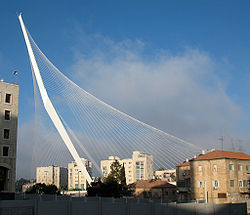 Before 1948, both the Jewish and the Arab populations of Jerusalem were scattered throughout the city. At the end of the War of Independence, when the city was partitioned into Israeli West Jerusalem and Jordanian East Jerusalem, a major population redistribution took place. The Jews in the Jewish Quarter of the Old City and the Arabs throughout West Jerusalem had to leave for the other side. As the old Arab neighborhoods in West Jerusalem were filled in with new Jewish residents, the municipality gave the neighborhoods new Hebrew names in an attempt to erase their history. So Talbiyeh became Komemiyut, Katamon became Gonen, and Baka became Geulim. Was this attempt successful? Yes, in the sense that the current residents of the old Arab mansions of Talbiyeh are still primarily Jewish. But in a linguistic sense, no: No one has heard of Komemiyut, Gonen, or Geulim, and everyone still uses the Arabic names (or Greek, in the case of Katamon).
And now history repeats itself. If you’ve been to Jerusalem in the last couple years, you’ve seen Rechov Yafo and other major streets all torn up for the construction of the new Jerusalem Light Rail, which runs through both West and “East” (actually north) Jerusalem. Now, as the project nears completion, and the engineering challenges of constructing new transportation infrastructure in an ancient and hilly city have all been met, the city faces what may prove to be a greater challenge: naming the stations.
The committee tasked with naming the stations received a proposal from linguist Dr. Avshalom Kor, who proposed giving all of the stations Hebrew names, regardless of how the locations are actually known. Haaretz reports:
The proposal most likely to prove controversial is the station in Shoafat, a neighborhood next to French Hill. The specific location of the station is known to the locals as Tel El Ful. Kor sneers at the name and proposes calling the station Givat Binyamin (Benjamin Hill), after the tribe of King Saul. Kor dedicates about half of his proposal to explaining the name change.
“Tel el Ful is the Arab name of our capital in the days of King Saul,” writes Kor, underlining the words “Arab” and “our”. “The Hebrew name was Givat Shaul or Givat Binyamin, after the king’s tribe. The name Givat Shaul is already taken by a neighborhood in West Jerusalem, therefore the station will be known as Givat Binyamin.”
Kor says that giving the station an Arab name would encourage illegal construction by Palestinians. “When we returned to this historic hill after the Six-Day War, it was bare except for King Hussein’s then unfinished villa at the top,” Kor says. “All the houses covering it now have been built, to my knowledge, illegally.”
He adds: “If it were not for the extensive illegal construction there, the hill today would bear the prestigious name of Givat Binyamin” - and he underlines the words “not” and “prestigious.”
Kor says: “Therefore, any potential request by the residents to give the station an Arab name would mean not just eradicating the Jewish past of the first capital of the Kingdom of Israel, but also acknowledging (yet again) the illegal construction in the area.”
We have obtained a copy of Kor’s memo, and he lists three more reasons for naming this particular station Givat Binyamin:
- Lebanon and Jordan are known to the world by their biblical names, and not by the local names Lubnan and Urdun.
- Quoting Genesis 26:18, “Isaac dug the wells which had been dug in the days of his father Abraham, and which the Philistines had stopped up after Abraham’s death, and he called them by the names that his father had called them.” (Is Kor going for a double entendre with the reference to Philistines?)
- “In Paris, for example, they would clearly name a station after an early French king’s capital, and not ‘Hill of Beans.’ And likewise we will name the station in honor of King Saul’s capital, and not ‘Tel al Ful’.”
Though Kor appears to be drawing an incendiary contrast between the cultured Europeans (or fictional versions of them whose views on kings are different from the actual French) and the residents of East Jerusalem, even the Europeans are not spared in his crusade for Hebrew names. He proposes naming the station on King George Street “Bikkur Cholim”, after the hospital whose name means “visiting the sick”, “an important site in the city’s history and an important mitzvah in Judaism”, rather than naming it after a British monarch.
And if you thought these stations could have both Hebrew and Arabic names, Kor’s proposal rules out that possibility. The proposal begins by saying that the Hebrew name will also appear in Arabic and Latin letters. “This way it is easier for tourists to find their way. If a tourist asks a Jerusalemite, for example, about ‘Ammunition Hill’, it is reasonable that the Jerusalemite will not know how to direct him. Therefore, in the three languages will be written, for example, ‘Givat Hatachmoshet’.”
Will Kor succeed in occluding Jerusalem’s diversity (and Israel’s multiple official languages) in favor of a Hebrew-only light rail, or will the unveiling of this proposal prompt a public backlash?
Ride the Purple Line this Shabbat!
(Crossposted to Jewschool.)

The short version: Segulah! DC’s newest independent minyan, with “full-liturgy, energizing, songful, and participant-led egalitarian davening in a warm and welcoming neighborhood community”. Shabbat morning services this week, January 2, 2010, 9:30 am, Shabbat Vayechi, Reamer Chapel at Tifereth Israel Congregation, 16th & Juniper St (7701 16th St NW; enter off Juniper), Washington DC, two-table potluck to follow at a nearby home. All ages are welcome. RSVP to segulahminyan at gmail or on Facebook, and/or join the email list.
The longer version:
All the way in the northernmost reaches of our nation’s capital, in the very last alphabet, is the neighborhood of Shepherd Park, and just over the Maryland line is the unincorporated urban area of downtown Silver Spring (home of NOAA, the American Film Institute, and the Discovery Channel). (The picture at right shows the north boundary stone marking the border between DC and Maryland.) This multistate (or one state and one something else) neighborhood is more affordable than central DC but more walking- and transit-friendly than the burbs, and therefore it’s no surprise that it contains one of the most diverse and fastest-growing Jewish scenes in the Washington area.
The Jewish epicenter of the neighborhood is upper 16th Street, or “Sheish Esrei Elyon”, where a single two-block stretch contains three congregations that are exceptional in different ways: Fabrangen is a historic first-wave havurah that started in 1971, born out of the activism of that time, and continues to this day. Ohev Sholom is an Orthodox synagogue that has reached out to the LGBT community. Tifereth Israel is home to JuggleK, a kashrut certification that certifies both conventional kashrut standards and ethical standards, whose first and only client is a vegan soup subscription service. Other Jewish highlights of the neighborhood include Moishe House Silver Spring, the offices of KOL Foods, and the former synagogue building that is now the Ethiopian Evangelical Church.
Segulah is the latest addition to this constellation, and meets in various locations on both sides of the state line. In addition to its other meanings, “Segulah” means “purple”, a reference to the Purple Line (pictured above) that will one day link Silver Spring to the other loose ends of the Washington Metro (and which Jews United For Justice is working on making fair). Attention New York: we challenge the Second Avenue Subway to a race!
In addition to being purple, Segulah is also a treasure! And we’ll be meeting this Shabbat to complete the book of Genesis, share song-filled prayer, and eat lunch. Details are at the top of this post. See you there!
Thursday, December 17, 2009
It was 20 years ago today
What were you doing 20 years ago tonight? I was watching The Simpsons Christmas Special, the half-hour episode that started it all. I was Bart's age in those days; now I'm closer to Homer's age. Twenty years and 449 episodes later, The Simpsons is still going strong. Congratulations on completing two decades!
Sunday, December 13, 2009
Wednesday, December 09, 2009
Fisk
I blogged previously about the URJ's Eilu V'Eilu series on independent minyanim. Now the series is complete. In week 3, Rabbi Sydney Mintz and Rabbi Elie Kaunfer responded to questions and comments from readers. Week 4, with their closing statements, was sent out on the email list but not (yet?) posted online.
In week 3, Rabbi Kaunfer responds to one question about education with an extended answer that appears to be an excerpt from his upcoming book. Rabbi Mintz responds to several questions, and one of them in particular highlights how many misunderstandings are still out there about independent minyanim and about Reform Judaism.
The questioner asks:
The secondary error is the implied syllogism "Mechon Hadar sees itself as providing resources for all independent minyanim; Mechon Hadar holds X views on halachah; therefore, all independent minyanim hold X views on halachah." This is along the lines of the famous "All men are mortal; Socrates is mortal; therefore, all men are Socrates." Mechon Hadar is just one organization, and is doing good work in the world, but has no authority to speak for all independent minyanim, nor does it claim to speak for all independent minyanim (not even for Kehilat Hadar). It provides resources that are there for whoever finds them useful.
Among the many flavors of independent minyanim, there are in fact some that take approaches that can be characterized more as "Reform" (for various values of "Reform"). Of course, there are still significant differences between those minyanim and conventional Reform synagogues, but the "conventional synagogue" part is more significant to those differences than the "Reform" part.
The questioner continues:
First of all, minyan participants are fleeing the Reform movement in droves too (survey results show that 44% of Kol Zimrah participants and 18% of independent minyan participants overall were raised with a Reform identity), and the Reform movement ignores these statistics to its peril. Fortunately, the existence of this dialogue indicates that some people in the Reform movement aren't ignoring it anymore.
Second of all, I have addressed the "not a halachic movement" claim in previous posts, so I'll just link there and not reinvent the wheel. All I'll say here is that this letter represents an extreme (small-c) conservative view of the nature of halachah. There is a growing grassroots movement out there to think about halachah as a "language of applied values" (or "critical common sense" or one of the other ways of referring to it). This approach positions itself in opposition to "formalism" -- viewing halachah as a formal system, focusing on the application of procedural rules and the "halachic process". So on the spectrum from critical common sense to formalism, the view of halachah in this letter appears to be waaaaay off the far end, past formalism. That is, the only way I can make sense out of "not a halachic movement (even though our rabbis have the capacity to provide responsa grounded in halachah)" is to understand halachah not merely as a process (which at least can continue to develop over time, even if this development is highly constrained) but as a fixed static set of legal texts. Thus, according to this view, Reform responsa can be "grounded in" that set of texts, but do not themselves constitute halachic works, and what Reform Jews do isn't halachic because it doesn't follow the conclusions of those texts. Of course, I think Reform Judaism should hold a progressive view of halachah, not an extreme conservative one. I hope I'm arguing with a straw man, but fear that I'm not.
This is neither interesting nor a thought experiment. It's not a thought experiment because it has been tried as a real experiment: Darkhei Noam and Kol Sasson are two examples of non-egalitarian independent minyanim that meet or have met in Reform synagogue buildings, successfully as far as I know. And it's not interesting because if an independent minyan (as distinct from a synagogue-sponsored minyan) makes an arrangement to meet in a synagogue (whether that arrangement includes paying rent or whatever other agreement they reach), the relationship between the minyan and the synagogue is one between sovereign entities, and therefore it shouldn't matter to the synagogue what exactly the minyan is doing as long as it doesn't interfere with the synagogue's own services or other activities. The independent minyanim that meet in churches are never asked whether their ritual practices conform to the church's principles.
The musical instrument question is particularly ill-posed (and I say this as a big supporter of musical instruments). "Forbidden"/"permitted" is almost never the right frame to think about musical instruments in services, since musical instruments played by people other than the service leaders are almost never "permitted". Generally, musical instruments are either used by the service leaders or not used at all. But if an independent minyan's practice is for the service leaders not to use musical instruments, this doesn't mean that the minyan holds that musical instruments are "forbidden". This is because independent minyan generally make decisions about policy (i.e. what they do), not about halachah (i.e. what everyone should do). There are all kinds of reasons why a minyan might decide not to use instruments, which need not involve taking a stance on whether instruments are forbidden. (For that matter, I suspect most independent minyanim don't have an official stance one way or the other on patrilineal descent.) And certainly, there is no fundamental Reform ideological opposition to having a service without instruments (I have been to many Reform services without instruments in my lifetime).
Yet this questioner seems to think there might be a problem with having a service without instruments using space in a Reform synagogue. What's the problem? They're not stopping anyone from using instruments in the sanctuary service. Is there a concern that the minyan participants are somehow going to take over the synagogue and mold it in their image? This is generally the last thing on a minyan's mind when it looks for space -- the minyan is operating much lower on Maslow's hierarchy, just looking for a place to hold services to maintain its existence, not thinking about future coups.
In week 3, Rabbi Kaunfer responds to one question about education with an extended answer that appears to be an excerpt from his upcoming book. Rabbi Mintz responds to several questions, and one of them in particular highlights how many misunderstandings are still out there about independent minyanim and about Reform Judaism.
The questioner asks:
In general, Rabbi Mintz is right in saying that we need to blow our own shofar. But even a cursory look at the halachic think tank at Mechon Hadar demonstrates that some of the differences between the minyanim and Reform Judaism will make the gap somewhat hard to bridge.The fundamental error here is assuming that structure and content are perfectly correlated, i.e. that because independent minyanim share an approach to the structure of Jewish community, they must also share views about Jewish ideology and practice. And I can see how someone might arrive at this assumption, since it's much more true in the synagogue movements. But as I showed in a recent post, "independent" Jewish individuals and communities come in all shapes and sizes, and as ZT showed, ideological categories and structural categories are often orthogonal. So comparing "the minyanim" and "Reform Judaism" is comparing apples and oranges, since the former is a structural category with diverse ideologies, and the latter (in the context it's being used here) is an ideological category.
The secondary error is the implied syllogism "Mechon Hadar sees itself as providing resources for all independent minyanim; Mechon Hadar holds X views on halachah; therefore, all independent minyanim hold X views on halachah." This is along the lines of the famous "All men are mortal; Socrates is mortal; therefore, all men are Socrates." Mechon Hadar is just one organization, and is doing good work in the world, but has no authority to speak for all independent minyanim, nor does it claim to speak for all independent minyanim (not even for Kehilat Hadar). It provides resources that are there for whoever finds them useful.
Among the many flavors of independent minyanim, there are in fact some that take approaches that can be characterized more as "Reform" (for various values of "Reform"). Of course, there are still significant differences between those minyanim and conventional Reform synagogues, but the "conventional synagogue" part is more significant to those differences than the "Reform" part.
The questioner continues:
Specifically, Reform Judaism is affirmatively not a halachic movement (even though our rabbis have the capacity to provide responsa grounded in halachah) and the Conservative Movement that minyanim members are fleeing in droves still claims to be halachic. The egalitarian nature of Reform Judaism will appeal to minyan'iks but they will ultimately reject our lack of halachah.
First of all, minyan participants are fleeing the Reform movement in droves too (survey results show that 44% of Kol Zimrah participants and 18% of independent minyan participants overall were raised with a Reform identity), and the Reform movement ignores these statistics to its peril. Fortunately, the existence of this dialogue indicates that some people in the Reform movement aren't ignoring it anymore.
Second of all, I have addressed the "not a halachic movement" claim in previous posts, so I'll just link there and not reinvent the wheel. All I'll say here is that this letter represents an extreme (small-c) conservative view of the nature of halachah. There is a growing grassroots movement out there to think about halachah as a "language of applied values" (or "critical common sense" or one of the other ways of referring to it). This approach positions itself in opposition to "formalism" -- viewing halachah as a formal system, focusing on the application of procedural rules and the "halachic process". So on the spectrum from critical common sense to formalism, the view of halachah in this letter appears to be waaaaay off the far end, past formalism. That is, the only way I can make sense out of "not a halachic movement (even though our rabbis have the capacity to provide responsa grounded in halachah)" is to understand halachah not merely as a process (which at least can continue to develop over time, even if this development is highly constrained) but as a fixed static set of legal texts. Thus, according to this view, Reform responsa can be "grounded in" that set of texts, but do not themselves constitute halachic works, and what Reform Jews do isn't halachic because it doesn't follow the conclusions of those texts. Of course, I think Reform Judaism should hold a progressive view of halachah, not an extreme conservative one. I hope I'm arguing with a straw man, but fear that I'm not.
On balance, then, I think Rabbi Mintz is correct that we should view and respond to minyanim as a challenge and an opportunity. One possible way would be to help unaffiliated minyanim with space and try and provide links for our members to participate in their worship. But here's an interesting thought experiment: Suppose a minyan wants to meet at our synagogue but refuses to count women as part of the minyan? What if it forbids musical instruments in the service? What if it wants to exclude our some of members from participation (or at least, from counting as part of a minyan) because they are Jews of only patrilineal descent? How would we deal with those issues?
This is neither interesting nor a thought experiment. It's not a thought experiment because it has been tried as a real experiment: Darkhei Noam and Kol Sasson are two examples of non-egalitarian independent minyanim that meet or have met in Reform synagogue buildings, successfully as far as I know. And it's not interesting because if an independent minyan (as distinct from a synagogue-sponsored minyan) makes an arrangement to meet in a synagogue (whether that arrangement includes paying rent or whatever other agreement they reach), the relationship between the minyan and the synagogue is one between sovereign entities, and therefore it shouldn't matter to the synagogue what exactly the minyan is doing as long as it doesn't interfere with the synagogue's own services or other activities. The independent minyanim that meet in churches are never asked whether their ritual practices conform to the church's principles.
The musical instrument question is particularly ill-posed (and I say this as a big supporter of musical instruments). "Forbidden"/"permitted" is almost never the right frame to think about musical instruments in services, since musical instruments played by people other than the service leaders are almost never "permitted". Generally, musical instruments are either used by the service leaders or not used at all. But if an independent minyan's practice is for the service leaders not to use musical instruments, this doesn't mean that the minyan holds that musical instruments are "forbidden". This is because independent minyan generally make decisions about policy (i.e. what they do), not about halachah (i.e. what everyone should do). There are all kinds of reasons why a minyan might decide not to use instruments, which need not involve taking a stance on whether instruments are forbidden. (For that matter, I suspect most independent minyanim don't have an official stance one way or the other on patrilineal descent.) And certainly, there is no fundamental Reform ideological opposition to having a service without instruments (I have been to many Reform services without instruments in my lifetime).
Yet this questioner seems to think there might be a problem with having a service without instruments using space in a Reform synagogue. What's the problem? They're not stopping anyone from using instruments in the sanctuary service. Is there a concern that the minyan participants are somehow going to take over the synagogue and mold it in their image? This is generally the last thing on a minyan's mind when it looks for space -- the minyan is operating much lower on Maslow's hierarchy, just looking for a place to hold services to maintain its existence, not thinking about future coups.
Saturday, November 21, 2009
Independent
(Crossposted to Jewschool.)
Blogging from the Bolt Bus on the way, appropriately, to the National Havurah Committee board meeting:
Nate Silver of FiveThirtyEight wrote this insightful post last fortnight following the elections:
Why did Democrats lose in Virginia and New Jersey on Tuesday? Because independent voters moved against them, say the pundits.
This is true [... b]ut it doesn’t really tell us very much. It’s a lot like saying: the Yankees won the Game 6 last night because they scored more runs than the Phillies. Or: the unemployment rate went up because there were fewer jobs.
It’s worth a read in its own right, but I want to focus on one section and draw an analogy to the Jewish community:
Part of the problem is that ‘independents’ are not a particularly coherent group. At a minimum, the category of ‘independents’ includes:
1) People who are mainline Democrats or Republicans for all intents and purposes, but who reject the formality of being labeled as such;
2) People who have a mix of conservative and liberal views that don’t fit neatly onto the one-dimensional political spectrum, such as libertarians;
3) People to the extreme left or the extreme right of the political spectrum, who consider the Democratic and Republican parties to be equally contemptible;
4) People who are extremely disengaged from politics and who may not have fully-formed political views;
5) True-blue moderates;
6) Members of organized third parties.These voters have almost nothing to do with each other and yet they all get grouped under the same umbrella as ‘independents’.
Similarly, many overlapping terms are used for Jewish individuals and communities who are not affiliated with any of the major denominations: independent, unaffiliated, nondenominational, postdenominational, Just Jewish, etc. Each of these terms connotes somewhat different shades of meaning, but even so, within each such category, and certainly within the union of all those categories, there are people who “have almost nothing to do with each other” except for what they aren’t. And so when we try to talk about people and communities outside the denomination, we suffer from the same confusion and conflation that Silver writes about, conflating essentially the same six categories that he lists (among others).
American political discourse often assumes incorrectly that all “independents” are in category 5, with positions right in between the Democrats and the Republicans (and so the way for a party to pick up these voters is to adopt some of the other party’s positions), when in fact there are other types of independents too. Similarly, until very recently, “unaffiliated”/”Just Jewish” was associated strongly with category 4: “People who are extremely disengaged from [Judaism]“. (It was recently enough that I had to write this article to explain to a mainstream Jewish audience that this isn’t always the case, though I think the other types of “independent”/”unaffiliated”/etc. Jews have gotten enough attention since then that maybe the points in that article are now obvious to everyone. But maybe not.) The survey results seem to indicate that this is still true of most people who check “Just Jewish”, though I wonder how much those results are contaminated by active independent/nondenominational/blah Jews who also think of themselves as “Just Jewish” and aren’t survey geeks and therefore don’t know that “Just Jewish” isn’t the option they’re supposed to pick.
Even worse, category 4 is sometimes conflated with category 3: Some think that people who are extremely disengaged from Judaism are on the extreme left! This is the idea behind phrases like “very Reform” and “ultra-Reform”. The analogy to American politics shows this conflation to be ridiculous: you can’t have extreme-left views if you don’t have fully-formed [political | Jewish] views. There are also people who hold extreme-left Jewish views (along one or more axes in n-dimensional space, some of which can be classified as left-right spectra), but this is a very different population from the apathetic masses.
Participants in independent minyanim and other unaffiliated/nondenominational communities are often mischaracterized as falling into just one of these categories, when the reality is that there is great diversity within and among such communities, so they can’t be neatly placed into just one. One common characterization of independent minyanim, particularly those of the “traditional egalitarian” style, is that they are “Conservative congregations flying a Liberian flag”, i.e. Conservative in everything but name, placing them in category 1. Another common characterization is that they fit between two denominations on a linear left-right spectrum (category 5), e.g. “to the right of Conservative and to the left of Orthodox” or “to the right of Reform and to the left of Conservative”. (The former is wrong on the facts in many cases, while the latter is simply incoherent.) And indeed, there are some individuals who see themselves as Conservative (or Orthodox or Reform) in everything but name (or even in name too) and are involved in nondenominational communities, and other individuals who identify as “Conservadox” or some other hybrid of multiple denominations. But independent/nondenominational communities also include plenty of people from category 2: those whose approaches to Judaism can’t be placed on a one-dimensional spectrum.
In the comments, feel free to add to the list of types of “independent” Jews.
Sunday, November 15, 2009
More press for independent minyanim
(Crossposted to Jewschool.)
Independent minyanim have been popping up all over the press lately. First of all, they make an appearance in this CNN piece on “New Jews”, but that deserves a whole snarky post of its own, so I’ll leave it alone for now.
Two articles focus on independent minyanim: one in the August/September issue of Hadassah Magazine (it’s old, I know, but it wasn’t available online when it first came out, so it seems to have slid under the blogosphere’s radar), and one (which is really four and counting) in the latest edition of the URJ’s Eilu V’Eilu.
What do all three pieces have in common? The obligatory quote from Jonathan Sarna, of course. Seriously, is it the law that he has to be quoted in every single one of these stories?
Anyway, the Hadassah piece is in some ways the usual story about independent minyanim, but it does a good job presenting the diversity of independent minyanim, discussing the wide range of different practices within and among minyanim. It also presents independent minyanim mostly in their own words and own ideas, defining them by what they are rather than what they’re not: “pluralism, egalitarianism, social justice and song-filled prayer”, “to take responsibility for our own Jewish lives”, “joy, reverence, inspiring prayer, high-level educational programming with support for beginners, a culture of cooperation and openness”, etc. Unlike other articles on this topic that have appeared in the Jewish press, there is no worrying about Jewish continuity or intermarriage or the future of the denominations, and there is a quote from a pulpit rabbi saying that independent minyanim are swell, since it is “exciting to see people serious about their Judaism and seeking to come closer to God in an active way.” There are a few glitches here and there: this article propagates the error (which was quickly fixed) from the initial release of the 2007 Spiritual Communities Study, saying that “more than half [of independent minyan participants] spent over four months on an Israel program”. (The actual survey question asked about spending more than four months in Israel, not specifying anything about a program.) In a closing section about what happens when minyan founders move out of a neighborhood, there is a sentence about some Tikkun Leil Shabbat founders that is technically correct yet amusing: “Novey and her husband travel to Tikkun Leil Shabbat on Friday nights from their Maryland home.” This makes it sound like they’re trekking into DC from deep suburbia or Baltimore or the Eastern Shore, when in fact their apartment (like my apartment down the street) is just a few feet from the DC line, in a Maryland neighborhood that is more urban than the adjoining parts of DC, and is much closer to TLS than (for example) the distance from Brooklyn to the Upper West Side. (We’ve even walked home from TLS, though it’s not a short walk.) Anyway, props to Hadassah for running this article (and a network of hospitals in Israel).
Eilu V’Eilu is a weekly email sent out by the Union for Reform Judaism, in which two writers each month debate some question, in the style of The Onion’s popular Point/Counterpoint feature (except that the writers are real people). And sometimes the two sides even disagree, but it seems that they don’t always check to see that the panelists actually have opposing views, so other times (such as when I participated) the two writers basically agree on the main points, and then are forced to search for minor points to rebut. (The best example of this was when the presidents of the Men of Reform Judaism and the Women of Reform Judaism faced off about whether there should still be single-sex congregational organizations. This is like the chairs of the DNC and the RNC “arguing” about whether there should be a two-party system.) This month’s dialogue fits into the latter mold. The question is “Are the growing numbers of independent minyanim a challenge to the movements?”, and the interlocutors are Rabbi Elie Kaunfer of Mechon Hadar and Rabbi Sydney Mintz of Congregation Emanu-El in San Francisco. As it turns out, both are supportive of independent minyanim. It might have been more fun, in a demolition derby kind of way, to see Rabbi Kaunfer go up against the old (hopefully straw-man by now) “Independent minyanim are destroying American Judaism by luring young adults away from the synagogues they would otherwise join” argument, but oh well.
In Week 1, Rabbi Kaunfer argues “Independent minyanim are not a challenge to the movements — the Internet is.” The point is that one-size-fits-all (or three-sizes-fit-all) movements are on the way out, since the Internet “allows people to organize into groups with very few start-up costs”, making it easier for communities to serve niche markets. Independent minyanim (independent of the major denominations) thrive in this new reality.
This is a positive development for Jewish life. When people care enough to stake out their own nuanced, complex relationship to Judaism, and reject broad labels in the process, they demonstrate that being Jewish matters deeply to them. If you claim to be “nondenominational,” people can’t make assumptions about your Jewish identity like they can when you claim a traditional denominational label. Instead, you have to explain what about Judaism you connect to—forming the baseline of a robust Jewish conversation.
Rabbi Kaunfer makes a solid argument that more segmentation is actually a good thing. I agree with the overall message, but unfortunately, there are a number of distracting minor issues with the article (though I’ll give the benefit of the doubt and assume based on past experience that some of these errors may be due to editing). Rabbi Kaunfer writes “New self-proclaimed movements sprung up — Reconstructionism, and the Renewal and Chavurah Movements.” The “Chavurah movement” is not now and has never been a “self-proclaimed movement” parallel to the “big three” or the Reconstructionist movement. Rabbi Kaunfer himself has argued for why the latest wave of independent minyanim do not constitute a “movement” in that mold, and the same is true for earlier waves of havurot. It goes on: “The lines between the big-three movements also blurred: what is the fundamental difference between the right wing of Reform and the left wing of Conservative, or between the right wing of Conservative and the left wing of Orthodoxy?” As I have argued before, the wing of Reform that he’s talking about (where one finds Hebrew, kashrut, etc.) is actually the left wing when viewed within an intra-Reform frame (rather than projecting frames of other denominations onto Reform); the right wing of Reform is the small-c conservative wing that holds onto tradition for tradition’s sake (aka Classical Reform). It’s the lefties of both movements that find common ground. (Cf. the advocates for the peace process are left-wing Israelis and left-wing Palestinians.)
Rabbi Kaunfer writes: “At Mechon Hadar, we have tracked the growth of independent minyanim (see www.mechonhadar.org). In the past ten years, they have exploded. In 2000, there were three of them; in 2009 there are more than sixty.” Here he is using the definition of “independent minyan” that was used in the 2007 Spiritual Communities Study. That study was only looking at communities founded since 1996. So what he means is that three independent minyanim were founded between 1996 and 2000 (and, possibly, still existed in 2007 — I’m not sure whether or not these figures include minyanim that ended before then), while many more were founded between 2000 and 2009. Yes, it’s true that the growth of independent minyanim has exploded in the last ten years, but this is a misleading way to show it. By this definition, no independent minyanim at all existed in 1995! This isn’t true, of course. For example, the Newton Centre Minyan qualifies as an independent minyan by most definitions, but it was founded in 1973. Rabbi Kaunfer links to this Zeek article which identifies differences between the minyanim founded in more recent years and the havurot founded in the ’70s, and as a general trend, these cultural differences are real, but it’s not a sharp line by any means. While Hadar and some other post-1996 minyanim may focus on “quality control”, plenty don’t and are included in the statistics nonetheless. The somewhat arbitrary cutoff of 1996 may have made sense for the survey, just so that there would be some boundaries in which communities are being studied, but I don’t think it makes sense going forward to define every community founded before 1996 as automatically not being an “independent minyan”.
Rabbi Mintz’s opening piece (which spreads the same inaccurate claims from the Spiritual Communities Study, inflating the growth rate of independent minyanim and repeating the “Israel programs” claim) is a very welcome voice to hear from the synagogue movements:
If independent minyanim can appeal to those who may not at this point in their lives step into a synagogue, why should we be threatened? Why shouldn’t we pay attention to where these young Jews are heading and strengthen our movement by creating vibrant minyanim of our own? No one is stopping us. [...] The Reform Jewish community needs to not only blow our own shofar, but also to listen closely to the new voices that are blowing our ancient instrument. They are showing us the possibility of a new engaged, immersed, committed generation.
Instead of suggesting that independent minyan participants are doing something wrong by building meaningful Jewish communities, or that it doesn’t matter because they’ll come crawling back when they have children, Rabbi Mintz is saying that synagogues and movements can look inward and learn from the successes of independent minyanim and use this to strengthen their own communities. This message is particularly welcome coming from the Reform movement, which thus far has not appeared to be as aware of the independent minyan phenomenon as the Conservative movement has been. Let’s hope this is where things are headed in the future.
In Week 2, Rabbi Kaunfer apparently didn’t see anything to dispute, so instead he asks and answers the question: “what is the future of the ‘alumni’ of independent minyanim?” And the answer is fantastic; you should just go and read it. The key point is that there’s not just one path that everyone takes when they get priced out of the old neighborhood, but many possibilities:
- More independent minyanim
- Minyan-synagogue hybrids [not to be confused with human-animal hybrids]
- Minyanim as training grounds for future synagogue members
- Rabbis who bring independent minyan ethos to their communities
- Minyan participation as a deviation from an otherwise unengaged Jewish life
Rabbi Mintz responds to something that isn’t actually what Rabbi Kaunfer said. She says she disagrees with his statement that the Internet is threatening the movements, and gives examples of how synagogues (not just independent minyanim) are using the Internet successfully to build community. But Rabbi Kaunfer wasn’t talking about synagogues, he was talking about movements. It’s important to keep the synagogue-vs.-minyan/havurah axis separate from the denominational-vs.-nondenominational axis separate in principle, even if they’re not entirely uncorrelated. And if anything, Rabbi Mintz’s examples support Rabbi Kaunfer’s claims: one of the examples she provides of a thriving synagogue is New York’s B’nai Jeshurun, which is not affiliated with a movement!
Coming next, in Week 3, they’ll respond to questions and comments sent in by readers.
Tuesday, November 10, 2009
Rabbi Yoffie endorses flexitarianism, the "kashrut establishment"
(Crossposted to Jewschool.)
Last week in Toronto, the Union for Reform Judaism held its biennial convention, and as in past years, URJ President Rabbi Eric Yoffie delivered a sermon laying out goals and initiatives for the next two years.
The sermon began with a great shout-out to the Biennial’s host country:
We Americans, it needs to be said, do not know Canada as well as we should. [...] I have a question for the Americans sitting in this congregation: How many of you can name the last three Prime Ministers of Canada?
Well, we Americans need to do better. The Canadian political system is far from perfect, but remember this: it has well-regulated banks; tough gun control laws; legalized marriage for gays; and an excellent, publicly-run health service - all matters of importance to Reform Jews and worthy of emulation by the United States.
This American (who can name the last three Canadian prime ministers and knows all the words to “O Canada”) says hear hear! (However, I was surprised that this was the only mention of health care, an issue that was featured so prominently two years ago, given that this sermon was just a few hours before the House passed the health care bill.)
The major initiatives are about food and technology. David A.M. Wilensky has already weighed in on the technology part, so I’ll leave that alone for now. There’s a lot to say about food; I’ll just focus on two points.
First, kudos to Rabbi Yoffie for endorsing flexitarianism (though he didn’t use that word). “Flexitarian”, the American Dialect Society’s 2003 Word of the Year, refers to someone who isn’t fully vegetarian but eats mostly vegetarian. There are different reasons for not eating meat, and a flexitarian lifestyle makes sense under some of these but not others. If you’re vegetarian because of a categorical opposition to eating meat, then being flexitarian doesn’t make sense, since eating any amount of meat is wrong. But even if you’re not opposed in general to eating meat, there are solid reasons for eating less meat than the standard American diet, mostly based on the effects of meat consumption. And if two people cut their meat consumption in half, that has the same effect as one person becoming fully vegetarian.
Rabbi Yoffie lays out some of the reasons for meat reductionism:
My proposal is this: let’s make a Jewish decision to reduce significantly the amount of red meat that we eat.
[...]
[M]eat consumption in North America has doubled in the last fifty years, and we can easily make do with far less red meat than we currently eat. And contrary to what many think, Jews are not obligated to eat meat on Shabbat and holidays. The Talmud suggests that fish and garlic are the foods that we should serve to honor Shabbat (Shabbat 118b); it also instructs us to eat meat in modest quantities (Hullin 84a). Remember too that in biblical Israel, the common diet consisted of barley bread, vegetables, and fruit, along with milk products and honey. My point is this: for the first 2,500 years of our 3,000 year history, Jews consumed meat sparingly, and we can surely do the same.And we must. The meat industry today generates nearly one-fifth of the man-made greenhouse gas emissions that are accelerating climate change throughout the world. According to a U.N. report, animal agriculture is responsible for more greenhouse gas than all transportation sources combined. And the preparation of beef meals requires about fifteen times the amount of fossil fuel energy than meat-free meals.
[...]
Professor Gidon Eshel of the Bard Center has suggested that the effect of reducing our collective meat consumption by twenty percent would be comparable to every American driving a Prius instead of a standard sedan. And this twenty percent reduction is something that every one of us - every Jew, every family, every synagogue - can do.
[...]
Perhaps we can begin by offering some Shabbat dinners and Passover Seders that will delight with their variety, creativity, and taste, and that will be a model for our members of healthy, festive, meat-free meals.
This is a way that non-vegetarians can make a real difference in our environmental impact and our use of resources. Vegetarian meals are already standard at public functions throughout much of independent progressive Jewish culture; this would be a welcome shift if the URJ brings it into mainstream Jewish institutions as well.
Unfortunately, Rabbi Yoffie’s sermon goes downhill after that:
What about kashrut? This is not about kashrut. There are many Reform Jews who find meaning in the observance of kashrut, wholly or in part, and we deeply respect their choice. But it is not a choice that the great majority of us want to make.
In fact, the rejection of kashrut was long a hallmark of North American Reform Judaism. Kauffman Kohler, an early leader of the Movement, proclaimed that “Judaism is a matter of conscience, not cuisine.” Ours is an ethically-based tradition, and Reform leaders saw no connection between the intricate rules of kashrut and ethical behavior. Sadly, for too much of the kashrut industry, this disconnect still exists; in recent years, kashrut authorities have failed in their duty to treat workers, immigrants, and animals with compassion and justice. For that reason, we applaud the Conservative movement for creating a new system of kosher certification that takes ethical factors into account.
Nonetheless, we - as a Movement - have put kashrut aside, and kashrut is not the issue for us. We do not accept the authority of the kashrut establishment, and its problems are for others to resolve.
What is he trying to accomplish here? Is this just a “No Ortho” disclaimer to preempt reactions along the lines of “I’m Reform, so you can’t tell me what not to eat”? Or is there something more to it?
The reason I find this problematic is, of course, framing. One could advocate for the exact same practices, but frame it differently, and the way Rabbi Yoffie framed it seems like a big missed opportunity.
He does note that ethical eating is about “what is proper and fit to eat”, a translation of “kashrut”:
But we do now realize that we need an approach of our own–our own definition of what is proper and fit to eat. Because our ethical commitments remain firm, and we understand - as we did not a century ago - that Jewish eating has a profoundly ethical dimension. We now know that God cares what we eat, and that eating can be an entrance to holiness. We now see that when we eat with mindfulness, even the humblest meal can become a sacred act.
But rather than framing this sacred eating as a form of kashrut (cf. the framing of “eco-kashrut” and the “Hekhsher Tzedek”), he frames it as “not kashrut”, with no connection to the dietary laws in the Torah and Talmud (which are part of the textual heritage of all Reform Jews, regardless of practice). He could instead have framed it as a modern application of those laws — not only in the general category of sacred eating, but in some of the specifics. For example, I see a strong connection between my kashrut observance and my meat reductionism, and find that one reinforces the other. Kashrut sharply limits what meat I can eat (I can’t just pick up a McDonald’s hamburger, or french fries for that matter), makes meat less accessible and more expensive (more accurately reflecting the true cost of meat consumption), and makes me think twice about eating meat even when I have kosher meat available to me (since it means no dairy concurrently or for a while afterwards). The original kashrut in Leviticus 17 restricted meat consumption even more, limiting it to sacrifices (until Deuteronomy came along and loosened the rules). (To have a brief “No Ortho” moment of my own, I find that these restrictions on meat, which I think of as being at the center of kashrut, lose some of their power if everything, even vegetables, can be considered “not kosher” based on where it was cooked or whether it’s broccoli. But that’s not an important point.) So when Rabbi Yoffie cites texts supporting meat reductionism, it’s strange that he doesn’t include the Torah’s most obvious example of a structure limiting meat consumption. This structure can be an inspiration for modern efforts at meat reductionism, whether or not those modern efforts incorporate specifics of that classical structure.
Rather than framing kashrut as something that has multiple approaches (which might include vegetarianism, eco-kashrut, the inaccurately named “Biblical kashrut”, etc.), Rabbi Yoffie says “There are many Reform Jews who find meaning in the observance of kashrut, wholly or in part”, suggesting (again) that there is a well-defined external definition of “wholly” observing kashrut, and that other kashrut practices are merely “in part”, and everyone’s kashrut practice is on a linear spectrum from 0 to 100.
Of course I agree with his condemnation of Agriprocessors et al., but when he (as the leader of the largest Jewish denomination in North America) implicitly equates kashrut with “the kashrut establishment” (see the parallelism in “…kashrut is not the issue for us. We do not accept the authority of the kashrut establishment…”), he also grants power to that establishment and in a sense does accept its authority, in the sense that he does not challenge the connection between kashrut and that establishment.
Also, the frame of “rejection of kashrut” is strange in the 21st century. As Rabbi Yoffie notes, the majority of Reform Jews don’t keep kosher. This means that the majority of Reform Jews in this generation (unlike in Kaufmann Kohler’s generation) can’t “reject” kashrut, since they didn’t have it in the first place. See this post and this post for more discussion of this point.
Oddly enough, if Reform congregations follow Rabbi Yoffie’s recommendations and hold more vegetarian events, they’ll actually be more accessible to people with various kashrut practices, though this is apparently just incidental.
Wednesday, November 04, 2009
One year later
So show us why we came here
Before we lay on the ground
Give it to us loud and clear
Make the devil turn around
The world around me’s turning
I’m just standing still
The time has come for changes
Do something or we will
--Phish, "Crowd Control"
(This is directed not only to the Obama administration, but to the "filibuster-proof" U.S. Senate majority, the Democratic majority in the New York Senate, and anyone else I helped elect on promises of change.)
Before we lay on the ground
Give it to us loud and clear
Make the devil turn around
The world around me’s turning
I’m just standing still
The time has come for changes
Do something or we will
--Phish, "Crowd Control"
(This is directed not only to the Obama administration, but to the "filibuster-proof" U.S. Senate majority, the Democratic majority in the New York Senate, and anyone else I helped elect on promises of change.)
Subscribe to:
Posts (Atom)